What Is a Token? A Complete Guide for Beginners
Tokens are one of the most important concepts in the cryptocurrency and blockchain ecosystem. You may have heard terms such as Bitcoin, Ethereum, stablecoins, utility tokens, governance tokens, or NFTs, but understanding exactly what a token is can sometimes be confusing.
At a basic level, a token is a digital asset or unit of value that exists on a blockchain. Tokens can represent many different things, from digital currencies and access to a service to voting rights, collectibles, ownership claims, or other forms of digital value.
Unlike some cryptocurrencies that operate on their own blockchain, many tokens are created on an existing blockchain using smart contracts or established token standards.
In this guide, we will explain what a token is, how tokens work, the difference between coins and tokens, the main types of tokens, how they are created, what they are used for, and the risks you should understand before using or investing in them.
What Is a Token?
A token is a digital representation of value, ownership, access, or another type of utility that is recorded and managed on a blockchain.
Tokens can represent almost anything that can be digitally defined.
For example, a token could represent a digital currency, access to an application, voting rights within a project, a collectible, or a claim associated with a particular asset.
One of the most important characteristics of tokens is that they can be programmable.
Using smart contracts, developers can create rules that determine how tokens are issued, transferred, used, or destroyed.
This programmability has helped create a wide range of applications within the cryptocurrency ecosystem.
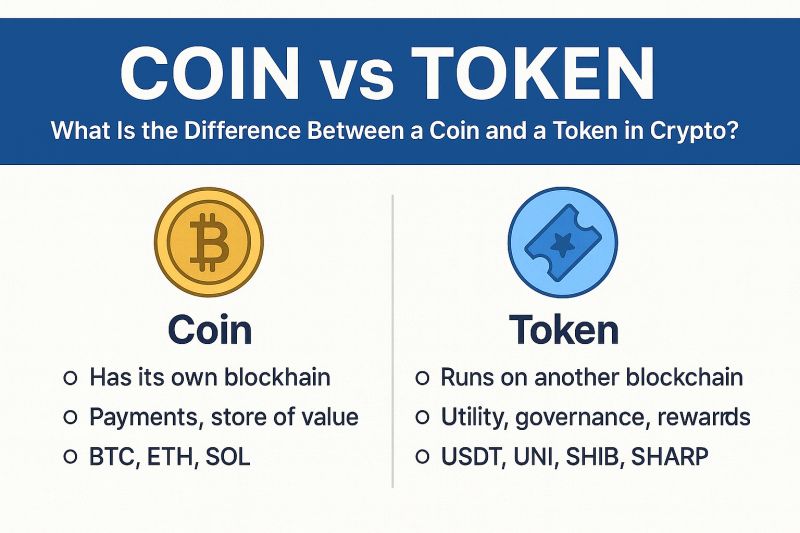
Tokens vs. Coins: What Is the Difference?
One of the most common questions beginners ask is the difference between a cryptocurrency coin and a token.
Although the terms are sometimes used interchangeably, there is an important distinction.
A coin generally refers to the native asset of a blockchain.
For example:
- Bitcoin (BTC) is the native asset of the Bitcoin blockchain.
- Ether (ETH) is the native asset of the Ethereum network.
- SOL is the native asset of the Solana network.
A token, on the other hand, is usually created and operates on an existing blockchain.
For example, thousands of tokens can operate on Ethereum without requiring each token to have its own independent blockchain.
The distinction is useful, although the terminology can vary between projects and communities.
How Do Tokens Work?
Tokens are typically created using smart contracts or token standards provided by a blockchain.
A smart contract can define the rules of the token.
These rules may specify:
- The total supply
- How new tokens can be created
- Whether tokens can be burned
- How tokens can be transferred
- Who can perform certain administrative functions
- How tokens interact with applications
Once deployed, the smart contract operates according to its programmed rules.
For example, an Ethereum-based token can use a standard that defines how balances and transfers are managed.
Applications, wallets, and exchanges can then interact with the token because they understand the standard used by the blockchain.
What Are Token Standards?
Token standards are technical specifications that define how tokens should behave on a blockchain.
One of the best-known examples is ERC-20, a standard widely used for fungible tokens on Ethereum.
ERC-20 provides a common set of functions that allows wallets, exchanges, and applications to interact with compatible tokens.
Another important standard is ERC-721, which is commonly associated with non-fungible tokens or NFTs.
There are also other standards designed for different types of assets and use cases.
These standards are important because they provide interoperability between tokens and the wider blockchain ecosystem.
Fungible vs. Non-Fungible Tokens
One of the most important distinctions is between fungible and non-fungible tokens.
Fungible Tokens
A fungible token is interchangeable with another token of the same type.
For example, if you own one unit of a particular fungible token, it is generally equivalent to another unit of that same token.
Traditional currencies are also fungible. One euro can normally be exchanged for another euro with the same value.
Many cryptocurrencies and stablecoins are fungible tokens.
Non-Fungible Tokens
A non-fungible token, commonly known as an NFT, is unique or individually distinguishable.
Each NFT can have its own identifier and characteristics.
NFTs have been used to represent digital artwork, collectibles, tickets, in-game assets, memberships, and other forms of digital ownership or access.
The value of an NFT depends on the specific asset, its utility, demand, scarcity, and other factors.
What Are Utility Tokens?
A utility token is designed to provide access to a particular product, service, or function within an ecosystem.
For example, a project might create a token that users need to pay transaction fees within an application.
A token could also provide access to certain features or services.
The exact utility depends on the project.
It is important to remember that simply calling a cryptocurrency a “utility token” does not guarantee that it has meaningful utility. Users should examine what the token actually does and whether the associated platform has real adoption.
What Are Governance Tokens?
Governance tokens can give holders certain rights to participate in the decision-making process of a blockchain project or decentralized application.
Depending on the system, token holders may be able to vote on proposals involving protocol parameters, upgrades, treasury spending, or other decisions.
However, governance models vary significantly.
Holding a governance token does not necessarily mean that the holder has legal ownership of a company.
The actual rights depend on the project’s governance system and applicable legal framework.
What Are Stablecoin Tokens?
Stablecoins are digital assets designed to maintain a relatively stable value compared with a reference asset.
Many stablecoins are issued as tokens on existing blockchains.
For example, a stablecoin may be designed to track the value of the US dollar.
Stablecoins can be used for trading, transfers, decentralized finance, and other applications.
However, not all stablecoins work in the same way.
Some are backed by reserves, while others use different mechanisms.
The quality, transparency, liquidity, and structure of the reserves can be important factors when evaluating a stablecoin.
What Are Security Tokens?
A security token is a digital token that can represent an investment or financial interest that falls under securities regulations.
Depending on the jurisdiction and the characteristics of the asset, a token representing shares, debt, or another investment interest may be subject to financial regulations.
This area is particularly important because the legal classification of tokens can vary between countries.
A token should not automatically be considered a security simply because it is digital. Its legal status depends on its characteristics and the laws that apply.
How Are Tokens Created?
Creating a token can be technically easier than creating an entirely new blockchain.
A developer can use an existing blockchain and deploy a smart contract that defines the token’s rules.
For example, a developer could create an Ethereum-compatible token by deploying a smart contract that follows the appropriate token standard.
The developer can define parameters such as the initial supply and distribution model.
However, creating a token is relatively easy from a technical perspective. Creating a successful and sustainable project is much more difficult.
A token needs a genuine use case, secure code, appropriate economic design, and users who actually want or need it.
What Is Tokenomics?
Tokenomics refers to the economic design of a cryptocurrency or token.
It includes factors such as:
- Total supply
- Circulating supply
- Token distribution
- Inflation or deflation
- Vesting schedules
- Token emissions
- Utility
- Incentive mechanisms
- Allocation for developers or investors
Tokenomics can have a major influence on how a project operates.
For example, if a large percentage of tokens is controlled by a small group of wallets, those holders may have significant influence over the market.
Similarly, if millions of new tokens are regularly released into circulation, the additional supply can affect the economic dynamics of the asset.
Understanding tokenomics is therefore an important part of researching a cryptocurrency project.
What Is Token Burning?
Token burning refers to the process of permanently removing tokens from circulation.
This is usually done by sending tokens to an address from which they cannot be recovered.
Some projects use token burns as part of their economic model.
The purpose can be to reduce the circulating supply or adjust certain incentives.
However, token burning does not automatically increase the price of an asset.
The market value of a token depends on many factors, including demand, utility, adoption, supply, market conditions, and investor expectations.
What Can Tokens Be Used For?
Tokens have a wide variety of applications.
They can be used as:
Digital currencies: Tokens can function as a medium of exchange within an ecosystem.
Access rights: A token may provide access to a service, platform, or feature.
Governance: Tokens can allow users to vote on certain protocol decisions.
Digital collectibles: NFTs can represent unique digital assets.
Financial assets: Certain tokens can represent interests in financial instruments or real-world assets, depending on their legal structure.
Rewards: Platforms can distribute tokens to users as incentives for participating in an ecosystem.
The flexibility of tokens is one of the reasons they have become so widespread.
Tokens and Decentralized Finance
Tokens play a major role in Decentralized Finance, commonly known as DeFi.
DeFi applications use smart contracts and blockchain networks to provide financial services without relying on the same traditional intermediaries.
Tokens can be used for lending, borrowing, trading, liquidity provision, and other financial activities.
For example, a user may deposit tokens into a decentralized protocol and receive another token representing their position in that system.
These applications can provide new financial tools, but they also introduce technical and financial risks.
Smart contract vulnerabilities, market volatility, liquidity problems, and economic attacks can result in significant losses.
Tokens and NFTs
The rise of NFTs demonstrated another major use case for tokens.
NFTs can provide a way to create unique digital assets that can be tracked on a blockchain.
They have been used in digital art, gaming, music, memberships, tickets, and collectibles.
However, owning an NFT does not automatically mean owning the copyright or intellectual property associated with the underlying content.
The rights attached to an NFT depend on the specific project and its terms.
This is an important distinction for anyone considering purchasing an NFT.
Risks of Tokens
Tokens can provide useful applications, but they also involve significant risks.
One of the biggest risks is price volatility.
Some tokens can experience extremely large price movements because of limited liquidity, speculation, or changing market sentiment.
There is also the risk of scams.
Creating a token can be relatively easy, which means that fraudulent projects can be launched quickly.
Another risk involves smart contracts. Bugs or vulnerabilities in the code can potentially lead to losses.
Token concentration is another issue. If a small number of wallets control a large percentage of the supply, those holders may have significant influence over the market.
Finally, regulatory treatment can vary depending on the token and jurisdiction.
How to Research a Token
Before purchasing or using a token, it is useful to conduct proper research.
Start by understanding what the project actually does.
Ask yourself:
- What problem is the project trying to solve?
- What is the token used for?
- Does the platform have real users?
- Who developed the project?
- Is the code publicly available?
- How is the token supply distributed?
- Are there large token unlocks coming?
- What blockchain does the token use?
- Are there smart contract audits?
- What risks are involved?
It is also important to be skeptical of projects that promise guaranteed profits or claim that their token price can only increase.
A professional-looking website does not necessarily mean that a project is legitimate.
The Future of Tokens
Tokens are likely to remain an important part of blockchain technology.
As the ecosystem develops, tokens may be used for an increasingly broad range of applications, including digital identity, financial instruments, loyalty programs, gaming assets, memberships, and representations of real-world assets.
Tokenization could potentially make certain assets easier to transfer and integrate into digital platforms.
However, technological development alone does not guarantee adoption.
Successful token projects will need to provide genuine utility, secure infrastructure, sustainable economic models, and clear benefits for users.
Regulation will also play an important role in determining how different types of tokens can be issued and used.
Conclusion
A token is a digital representation of value, ownership, access, utility, or another type of asset or right that is recorded on a blockchain.
Unlike native coins such as BTC or ETH, tokens are often created on existing blockchain networks using smart contracts and established technical standards.
There are many different types of tokens, including fungible tokens, NFTs, utility tokens, governance tokens, stablecoins, and tokens that may represent financial or real-world assets.
Their flexibility has made them one of the most important components of the blockchain ecosystem.
However, creating a token is relatively easy, while building a valuable and sustainable project is much more difficult. Investors and users should therefore look beyond the token’s price and carefully examine its purpose, technology, distribution, tokenomics, security, and adoption.
Tokens demonstrate one of the most powerful ideas behind blockchain technology: digital assets can be programmed with specific rules and transferred through decentralized networks, opening the door to new forms of ownership, access, governance, and value exchange.
