Cryptocurrency Security and Wallets: A Complete Guide for Beginners
Cryptocurrency security is one of the most important topics every digital asset user should understand.
Unlike traditional bank accounts, cryptocurrency can give users direct control over their money through blockchain technology. This can provide greater independence, but it also means that users are often responsible for protecting their own assets.
A cryptocurrency wallet does not technically store coins in the same way that a physical wallet stores cash. Instead, a wallet manages the cryptographic keys that allow users to interact with assets recorded on a blockchain.
Understanding how wallets, private keys, public addresses, and recovery phrases work is essential for anyone who owns cryptocurrency.
Security is particularly important because blockchain transactions are generally irreversible. If cryptocurrency is sent to the wrong address or an attacker obtains the credentials needed to control a wallet, recovering the funds can be extremely difficult or impossible.
In this guide, we will explain what cryptocurrency wallets are, how they work, the difference between hot and cold wallets, hardware wallets, private keys, seed phrases, wallet addresses, common scams, and the best practices for protecting digital assets.
What Is a Cryptocurrency Wallet?
A cryptocurrency wallet is a tool that allows users to interact with blockchain networks.
Depending on the type of wallet, it can allow users to:
- Receive cryptocurrency
- Send cryptocurrency
- View balances
- Sign transactions
- Interact with decentralized applications
- Manage digital assets
The cryptocurrency itself is recorded on the blockchain.
The wallet provides the tools and cryptographic keys necessary to control those assets.
This is an important distinction because beginners sometimes imagine that cryptocurrency is physically stored inside an application.
Instead, ownership is represented by blockchain records, while the wallet manages the credentials used to authorize transactions.
Public Addresses and Private Keys
Two fundamental concepts in cryptocurrency security are public addresses and private keys.
A public address can be shared with other people so they can send cryptocurrency to you.
A private key is secret information that can be used to authorize transactions from the associated address.
A simple analogy is a mailbox.
The public address is similar to the address of the mailbox.
The private key is more like the key that gives control over what is inside.
Sharing your public address is generally necessary for receiving cryptocurrency.
Sharing your private key can give another person control over your assets.
For this reason, private keys must remain confidential.
What Is a Seed Phrase?
Many cryptocurrency wallets use a seed phrase, also called a recovery phrase or secret recovery phrase.
A seed phrase is usually a sequence of words generated when a wallet is created.
It can be used to restore access to the wallet and the accounts associated with it.
Depending on the wallet standard, the phrase may contain a specific number of words.
The exact format depends on the wallet implementation.
The seed phrase is extremely sensitive information.
Anyone who obtains it may potentially gain control over the assets associated with that wallet.
For this reason, it should never be shared with another person, including someone claiming to be customer support.
How to Protect a Seed Phrase
Protecting your recovery phrase is one of the most important cryptocurrency security practices.
Avoid storing it in:
- Social media messages
- Online notes
- Cloud documents
- Screenshots
- Unencrypted text files
Digital copies can potentially be exposed through malware, compromised accounts, or cloud breaches.
Many users prefer to write their recovery phrase down and store it securely offline.
Some advanced users use specialized physical storage designed to protect recovery phrases against physical damage.
The most important principle is simple:
Your recovery phrase should remain private and accessible only to you.
Hot Wallets
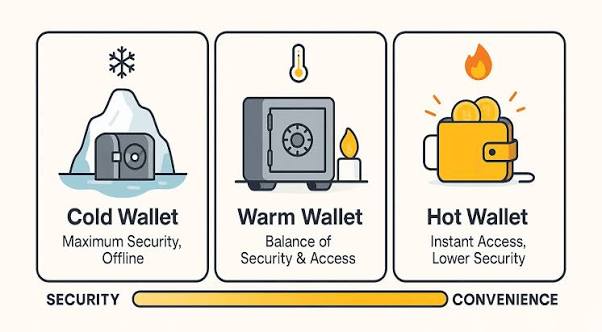
A hot wallet is a cryptocurrency wallet that is connected to the internet.
Examples can include:
- Mobile wallets
- Desktop wallets
- Browser-based wallets
- Web wallets
Hot wallets are generally convenient.
They make it easy to interact with decentralized applications and send cryptocurrency quickly.
However, being connected to the internet can increase exposure to online threats.
Malware, phishing attacks, malicious websites, and compromised devices can create security risks.
For this reason, hot wallets are often more appropriate for smaller amounts used regularly rather than storing an entire long-term portfolio.
Cold Wallets
A cold wallet is a method of keeping cryptocurrency keys offline or otherwise isolated from routine internet exposure.
Cold storage is generally designed to reduce exposure to online attacks.
One common form of cold storage is a hardware wallet.
Other approaches can involve offline key management, although they require significant technical knowledge and careful procedures.
Cold storage can provide strong security, but it is not automatically risk-free.
Physical loss, theft, damage, incorrect backups, or user mistakes can still create problems.
Hardware Wallets
Hardware wallets are physical devices designed to manage cryptocurrency keys while keeping sensitive information isolated from general-purpose computers or phones.
When properly configured, a hardware wallet can reduce the risk of exposing private keys to potentially compromised devices.
Hardware wallets are commonly used by people holding cryptocurrency for longer periods.
However, buying a hardware wallet does not automatically make an investor safe.
Users must still protect:
- The device
- The PIN
- The recovery phrase
- Backup information
They must also follow the manufacturer’s security instructions.
Software Wallets
Software wallets are applications that manage cryptocurrency keys.
They can be installed on:
- Smartphones
- Computers
- Browsers
Software wallets are convenient and often free.
They can be useful for everyday transactions and interacting with decentralized applications.
However, the security of a software wallet is partly dependent on the security of the device running it.
If a computer or smartphone is infected with malware, wallet credentials may potentially be exposed.
Custodial vs. Non-Custodial Wallets
Another important distinction is between custodial and non-custodial solutions.
Custodial Wallets
With a custodial service, another company generally controls the private keys on behalf of the user.
Cryptocurrency exchanges commonly operate this way.
The advantage is convenience.
Users can often recover access through account-recovery procedures if they lose a password.
The disadvantage is that users depend on the service provider.
If the provider experiences a security incident, operational failure, insolvency, or regulatory restriction, access to assets may potentially be affected.
Non-Custodial Wallets
With a non-custodial wallet, the user controls the private keys.
This provides greater direct control.
However, it also means greater responsibility.
If the user loses the recovery phrase and has no alternative recovery method, there may be no third party capable of restoring access.
“Not Your Keys, Not Your Coins”
The phrase “not your keys, not your coins” is commonly used in the cryptocurrency community to describe the difference between custodial and self-custody arrangements.
The phrase emphasizes that users who do not control the private keys are relying on another organization to manage the assets.
However, self-custody is not automatically safer for everyone.
It requires users to understand wallet security, backups, transaction verification, phishing protection, and operational security.
The best custody method depends on the user’s knowledge, circumstances, and risk tolerance.
Wallet Addresses
A cryptocurrency address is a destination used to receive digital assets.
Addresses can vary significantly depending on the blockchain.
For example, Bitcoin addresses and Ethereum addresses use different formats and systems.
Some blockchain networks also support multiple address formats.
Before sending cryptocurrency, always verify:
- The recipient address
- The cryptocurrency
- The blockchain network
- Any required memo or destination tag
Sending funds to an incompatible network or incorrect address can result in permanent loss.
Test Transactions
When transferring a significant amount of cryptocurrency, some users choose to make a small test transaction first.
The purpose is to confirm that:
- The address is correct
- The network is correct
- The funds arrive successfully
After confirming the test transaction, the remaining amount can be transferred.
A test transaction does not eliminate all risks, but it can reduce the chance of making certain operational mistakes.
Two-Factor Authentication
Two-factor authentication, commonly called 2FA, provides an additional layer of protection for online accounts.
Instead of relying only on a password, the user must provide a second authentication factor.
Depending on the service, this may involve:
- Authentication applications
- Hardware security keys
- Other verification methods
Where available, stronger authentication methods can provide better protection than relying solely on passwords.
Never share authentication codes with someone who contacts you unexpectedly.
Password Security
Strong password practices are essential for cryptocurrency users.
Avoid using the same password across multiple services.
A compromised password from another website could potentially be used to attack your cryptocurrency account if the same password has been reused.
Password managers can help users create and securely store unique passwords.
For important financial accounts, unique credentials are particularly important.
Phishing Attacks
Phishing is one of the most common security threats in cryptocurrency.
Attackers may create fake websites, emails, messages, or applications designed to look legitimate.
They may attempt to convince users to enter:
- Passwords
- Recovery phrases
- Private keys
- Authentication codes
A phishing message may create a sense of urgency.
For example, it might claim that your wallet has been suspended or that you must verify your account immediately.
Do not allow urgency to override security procedures.
Access cryptocurrency services through official applications or websites whenever possible.
Fake Customer Support
Cryptocurrency users are frequently targeted by fake support accounts.
A scammer may contact you through social media and claim to represent a wallet, exchange, or blockchain project.
They may ask for your recovery phrase or request that you transfer cryptocurrency.
Legitimate customer-support representatives should never need your private recovery phrase to access your wallet.
If someone asks for it, treat the request as a serious warning sign.
Fake Wallet Applications
Users should be careful when downloading cryptocurrency wallets.
Scammers can create applications that imitate legitimate wallets.
A fake application may attempt to steal private keys or recovery phrases.
Only download wallet software from official sources and verify the application’s authenticity.
Do not install wallet software simply because someone sends you a download link.
Malware and Cryptocurrency
Malware can pose a serious threat to cryptocurrency users.
Certain malicious programs can attempt to:
- Steal passwords
- Monitor clipboard activity
- Capture sensitive information
- Access wallet files
- Redirect cryptocurrency addresses
Clipboard attacks are particularly dangerous.
A user may copy a cryptocurrency address and unknowingly have it replaced by malware with an attacker’s address.
Always verify the destination address on the device or hardware wallet before confirming an important transaction.
Hardware Wallet Supply-Chain Risks
Buying a hardware wallet from an unofficial source can create additional risks.
A device could potentially have been tampered with before reaching the customer.
For this reason, users should purchase hardware wallets through trusted official channels whenever possible.
Follow the manufacturer’s instructions for verifying the device.
Never use a recovery phrase supplied by someone else.
A new wallet should normally generate its own recovery information during setup.
Backup Strategies
A cryptocurrency wallet should have a reliable backup strategy.
If the device containing the wallet is lost or damaged, a properly protected recovery method may allow the user to restore access.
However, backups create another security challenge.
If too many copies of a recovery phrase exist, the chance of exposure increases.
If there are no backups, physical loss or damage can create serious problems.
The objective is to find a secure balance between accessibility and protection.
Physical Security
Digital security is only part of cryptocurrency security.
Physical security also matters.
Someone who obtains your hardware wallet, PIN, or recovery phrase may potentially gain access to your funds.
Recovery phrases should therefore be stored somewhere physically secure.
Consider risks such as:
- Theft
- Fire
- Water damage
- Unauthorized access
- Accidental destruction
Some users use durable physical backup solutions for long-term storage.
Wallet Security and Public Wi-Fi
Public Wi-Fi networks can introduce additional security risks.
When accessing cryptocurrency services, users should be cautious about connecting through unknown networks.
Avoid performing sensitive financial operations on networks you do not trust.
Keeping your devices and applications updated can also reduce exposure to known vulnerabilities.
Decentralized Applications and Wallet Permissions
Cryptocurrency wallets can interact with decentralized applications, commonly known as dApps.
When connecting a wallet to an application, users may be asked to approve certain permissions or transactions.
These permissions should be reviewed carefully.
A malicious or compromised application may attempt to obtain more control than the user expects.
Do not approve transactions simply because a website tells you to do so.
Understand what you are signing whenever possible.
Smart Contract Approvals
Some blockchain ecosystems allow tokens to be approved for use by smart contracts.
This can create additional risks if users grant permissions to malicious or compromised contracts.
Users should periodically review token approvals where appropriate and revoke unnecessary permissions using reputable tools.
However, users should understand the network and transaction fees involved before making changes.
Common Cryptocurrency Security Mistakes
Several mistakes are particularly common among beginners.
Sharing a Recovery Phrase
Never share your recovery phrase with another person.
Storing the Phrase Online
Online storage can expose sensitive information to attackers.
Clicking Unknown Links
Suspicious links can lead to phishing websites or malicious applications.
Ignoring Transaction Details
Always verify addresses and networks.
Reusing Passwords
A compromised password can expose multiple accounts.
Keeping Everything on One Device
A single compromised device can create significant risk.
Investing in Fake Projects
Research projects carefully before sending funds.
A Simple Cryptocurrency Security Checklist
Before using a cryptocurrency wallet, consider the following:
Wallet
- Is the wallet from a trusted source?
- Is it updated?
- Do you understand whether it is custodial or non-custodial?
Recovery Phrase
- Is it stored offline?
- Is it private?
- Do you have a secure backup?
Account Security
- Do you use a unique password?
- Is two-factor authentication enabled where appropriate?
Transactions
- Have you verified the address?
- Have you confirmed the blockchain network?
- Are any required tags or memos correct?
Applications
- Do you trust the decentralized application?
- Do you understand what you are signing?
Device
- Is your operating system updated?
- Is your device protected from unauthorized access?
- Do you avoid installing suspicious software?
How to Choose a Cryptocurrency Wallet
There is no single wallet that is perfect for everyone.
Consider your needs.
If you make frequent transactions and interact with decentralized applications, a software wallet may offer greater convenience.
If you hold cryptocurrency for a long period and prioritize reducing online exposure, a hardware wallet may be more appropriate.
If you prefer simplicity and do not want to manage private keys yourself, you may choose a reputable custodial service.
The most important factor is understanding the responsibilities associated with your chosen method.
The Principle of Security Over Convenience
Cryptocurrency security often involves a trade-off between convenience and control.
A highly convenient system may involve more reliance on third parties.
A highly secure self-custody setup may require more technical knowledge and personal responsibility.
Neither approach is automatically perfect.
The goal is to choose a security model appropriate for the value being protected and the user’s level of experience.
Conclusion
Cryptocurrency wallets are essential tools for interacting with blockchain networks, but understanding how they work is just as important as choosing the right wallet.
The most important concepts include private keys, public addresses, seed phrases, hot wallets, cold wallets, hardware wallets, custodial services, and self-custody.
Security should always be treated as a fundamental part of cryptocurrency ownership.
Protect your recovery phrase, use strong and unique passwords, enable appropriate authentication methods, verify transaction addresses, avoid suspicious links, and be extremely cautious with anyone asking for private wallet information.
Remember that cryptocurrency transactions are generally irreversible.
A simple mistake can therefore have serious consequences.
At the same time, security does not mean making cryptocurrency inaccessible or unnecessarily complicated.
The best approach is to develop a practical system that balances security, convenience, and your individual needs.
For small amounts used frequently, convenience may be important.
For larger long-term holdings, stronger security and offline storage may deserve greater attention.
Above all, remember one fundamental rule:
Never share your private keys or recovery phrase with anyone.
No legitimate person needs your recovery phrase to send you cryptocurrency, provide basic customer support, or “unlock” your wallet.
By understanding how cryptocurrency wallets work and following strong security practices, users can significantly reduce avoidable risks and take greater control of their digital assets.
