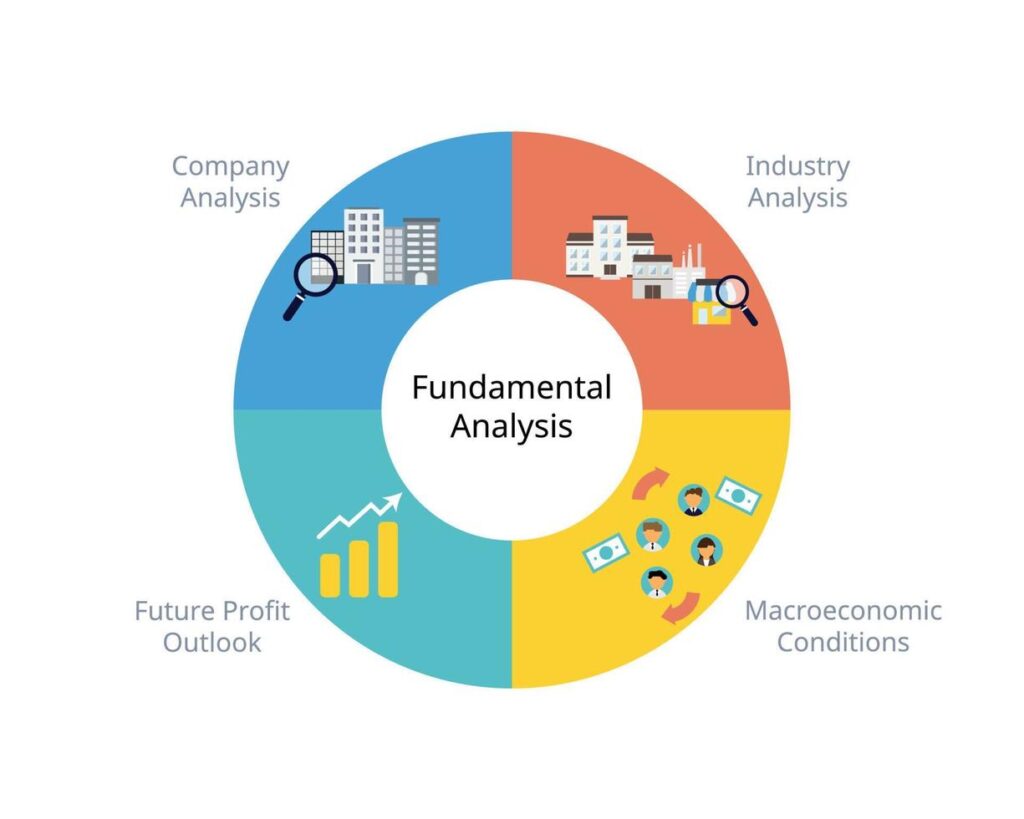
Fundamental Analysis in Cryptocurrency: A Complete Guide
Fundamental analysis is one of the most useful methods for evaluating a cryptocurrency project beyond its market price.
While technical analysis focuses primarily on price charts, trading patterns, indicators, and market movements, fundamental analysis looks at the underlying characteristics of a cryptocurrency or blockchain project.
The objective is to understand what a project does, why it exists, how its network works, how its token is structured, whether people are actually using it, and what factors could influence its long-term development.
In traditional financial markets, fundamental analysis often involves studying company revenues, profits, assets, debt, management, and competitive advantages.
Cryptocurrency requires a different approach.
Most blockchain projects are not traditional companies, and many do not have conventional financial statements. Instead, analysts can examine on-chain activity, tokenomics, developer activity, network adoption, governance, security, and other publicly available information.
Fundamental analysis does not guarantee that a cryptocurrency will increase in price.
A project can have strong fundamentals while its token price falls.
Likewise, an asset with weak fundamentals can experience a significant price increase during a speculative market.
For this reason, fundamental analysis should be viewed as a research framework rather than a prediction tool.
What Is Fundamental Analysis?
Fundamental analysis is the process of evaluating the underlying characteristics and potential value of an asset.
In cryptocurrency, this means looking beyond the price chart.
Instead of asking only, “Is this cryptocurrency going up?”, fundamental analysis asks questions such as:
- What problem does this project solve?
- Does the technology provide something useful?
- Are people actually using the network?
- Who is developing the project?
- How is the token distributed?
- How much new supply can enter the market?
- Does the token have genuine utility?
- How does the project compare with competitors?
- Is the network secure?
- Is the ecosystem growing?
These questions can help investors develop a more complete understanding of a cryptocurrency.
Fundamental Analysis vs. Technical Analysis
Fundamental and technical analysis approach the market from different perspectives.
Technical analysis primarily studies historical price and volume data.
Traders may use:
- Support and resistance
- Moving averages
- Trend lines
- Candlestick patterns
- Trading volume
- Relative Strength Index
- MACD
Fundamental analysis focuses on the underlying project.
An analyst may examine:
- Technology
- Tokenomics
- Network activity
- Adoption
- Developers
- Community
- Competition
- Governance
- Security
- Market structure
The two approaches can also be combined.
For example, an investor could use fundamental analysis to identify projects worth researching and technical analysis to study potential entry or exit points.
Why Fundamental Analysis Matters in Crypto
Cryptocurrency markets are heavily influenced by narratives.
A project can become popular because of social media, influencers, marketing campaigns, exchange listings, or speculation.
However, popularity does not necessarily mean that a project has strong fundamentals.
Fundamental analysis provides a framework for separating the underlying characteristics of a project from short-term market excitement.
It can also help investors compare different cryptocurrencies using similar criteria.
A structured framework is particularly useful because no single metric can accurately describe the health of an entire blockchain ecosystem.
1. Understand the Project
The first step in fundamental analysis is understanding what the project actually does.
Read the project’s official documentation, technical material, and available research.
Ask:
What problem is being solved?
A strong project should have a clearly defined purpose.
Who is the target user?
Is the project designed for consumers, developers, businesses, financial institutions, traders, or another group?
Why does it need blockchain technology?
Not every problem requires a blockchain.
If a project could easily operate using a traditional centralized database, its blockchain-based design deserves additional scrutiny.
What makes the project different?
A cryptocurrency should ideally have a clear reason for existing.
2. Analyze the Technology
Technology is an important part of fundamental analysis.
Different blockchains use different architectures and consensus mechanisms.
For example:
- Bitcoin uses Proof of Work.
- Ethereum uses Proof of Stake.
- Cardano uses Ouroboros Proof of Stake.
- Other networks use different consensus designs.
An analyst should understand how the network processes transactions and what trade-offs it makes.
Important questions include:
- How fast are transactions?
- What are typical transaction costs?
- How scalable is the network?
- How decentralized is it?
- How secure is the consensus mechanism?
- Can developers build applications on it?
- Does the technology have limitations?
Technical complexity alone does not make a project valuable.
The important question is whether the technology provides useful functionality and whether the network can deliver it reliably.
3. Examine Tokenomics
Tokenomics refers to the economic structure of a cryptocurrency.
It is one of the most important elements of fundamental analysis.
Tokenomics can include:
- Maximum supply
- Total supply
- Circulating supply
- Issuance
- Inflation
- Token distribution
- Vesting schedules
- Unlocks
- Token utility
- Staking
- Burning mechanisms
Understanding supply is particularly important.
A project may appear to have a relatively small market capitalization because only a portion of its total tokens are currently circulating.
If a large number of additional tokens are scheduled to enter circulation, existing holders could face dilution.
Market Capitalization and Fully Diluted Valuation
Market capitalization is generally calculated by multiplying the current token price by the circulating supply.
For example:
Market Capitalization = Token Price × Circulating Supply
Fully diluted valuation, or FDV, attempts to represent the value of all tokens if the entire potential supply were circulating.
Comparing market capitalization with FDV can therefore provide useful information about future dilution.
A large difference between the two can indicate that substantial amounts of supply remain locked or are scheduled to enter circulation.
This does not automatically mean that a project is overvalued.
It simply means that future supply should be considered.
4. Analyze Token Utility
A cryptocurrency should ideally have a clear function within its ecosystem.
Token utility can include:
- Paying network fees
- Staking
- Governance
- Accessing applications
- Collateral
- Providing liquidity
- Securing a network
However, the existence of a token does not automatically create demand.
The important question is whether the token’s utility creates meaningful economic demand.
For example, if a blockchain requires its native token to pay transaction fees, network activity can create a direct reason for users to acquire the asset.
5. Examine Network Activity
One of the advantages of blockchain technology is that much of the network’s activity can be publicly observed.
On-chain metrics can provide information about how a blockchain is being used.
Important metrics can include:
- Active addresses
- Transaction count
- Transaction volume
- Fees
- Total value locked
- Staking participation
- Stablecoin activity
Active addresses can provide an indication of network participation.
However, they should not be interpreted in isolation.
One person or organization can control multiple addresses, and automated systems can generate transactions.
For this reason, analysts should combine several metrics rather than relying on a single number.
6. Look at Transaction Activity
Transaction activity can help determine whether a network is actually being used.
An increase in transactions may indicate growing adoption.
However, high transaction numbers do not automatically mean that a blockchain is successful.
Transactions can be generated by:
- Bots
- Arbitrage
- Automated applications
- Spam
- Incentive programs
The quality of activity is therefore important.
An analyst should ask whether transaction growth represents genuine economic activity or temporary activity created by incentives.
Sustained usage is generally more informative than a short-term spike.
7. Analyze Fees and Revenue
Transaction fees can provide another useful signal.
When users pay fees to use a blockchain or protocol, those fees can indicate demand for the underlying infrastructure.
For certain protocols, analysts can also examine revenue and compare it with market capitalization.
However, not every cryptocurrency protocol generates revenue in the same way.
Some networks may prioritize security, decentralization, or other objectives rather than direct financial revenue.
Therefore, financial metrics should always be interpreted in the context of the specific project.
8. Examine Developer Activity
Developers are extremely important to blockchain ecosystems.
A project needs developers to:
- Build new features
- Fix bugs
- Improve security
- Upgrade infrastructure
- Develop applications
- Maintain existing software
Public developer activity can therefore provide useful information about a project’s development.
Analysts may examine indicators such as:
- Number of active contributors
- Code commits
- Software releases
- Protocol upgrades
- Developer retention
Developer activity should not be treated as a simple score.
A large number of commits does not necessarily mean better development.
Quality, relevance, and consistency matter.
Nevertheless, a project with little or no meaningful development activity may deserve additional scrutiny.
9. Study the Team and Leadership
Some cryptocurrency projects have identifiable founders and development teams.
Others are more decentralized.
When a team is publicly known, it can be useful to investigate its:
- Experience
- Previous projects
- Technical background
- Reputation
- Transparency
- Long-term involvement
A famous founder does not guarantee success.
Likewise, an anonymous development team is not automatically a sign of failure.
The important question is whether the project has the people and infrastructure necessary to continue developing and maintaining the network.
10. Evaluate Adoption
Technology is only useful if people actually use it.
Adoption is therefore one of the most important aspects of fundamental analysis.
Consider:
- Number of users
- Active wallets
- Developer adoption
- Applications
- Transaction activity
- Institutional usage
- Merchant adoption
- Ecosystem growth
A project with strong technology but little adoption faces a different situation from a project with a large and active user base.
Long-term growth in genuine users can be an important signal.
11. Analyze the Ecosystem
A blockchain’s ecosystem can provide additional information about its health.
For smart-contract platforms, examine the number and quality of applications being developed.
These may include:
- Decentralized exchanges
- Lending platforms
- NFT marketplaces
- Games
- Stablecoins
- Payment applications
- Social applications
- Infrastructure services
A growing ecosystem can create network effects.
More users can attract developers.
More developers can create more applications.
More applications can attract additional users.
This cycle can potentially strengthen the network over time.
12. Examine Total Value Locked
Total Value Locked, commonly called TVL, is frequently used when analyzing decentralized finance ecosystems.
TVL represents the value of assets deposited or locked in certain DeFi protocols.
It can provide information about the amount of capital participating in an ecosystem.
However, TVL has limitations.
The value can change simply because cryptocurrency prices change.
Incentive programs can also temporarily increase TVL.
Therefore, TVL should be considered alongside users, transaction activity, fees, and retention.
13. Analyze Competition
No cryptocurrency exists in isolation.
Every project competes for users, developers, liquidity, capital, and attention.
When analyzing a project, identify its main competitors.
Ask:
- What alternatives already exist?
- Is the project faster?
- Is it cheaper?
- Is it more decentralized?
- Does it have better developer tools?
- Does it have stronger liquidity?
- Does it offer a unique feature?
- Does it have a stronger network effect?
A project’s competitive advantage is sometimes called its moat.
A strong moat can make it more difficult for competitors to replace the network.
14. Examine Security
Security should be a central part of fundamental analysis.
Blockchain projects can face:
- Smart-contract vulnerabilities
- Consensus attacks
- Bridge exploits
- Oracle failures
- Private-key compromises
- Governance attacks
- Exchange hacks
For DeFi protocols, examine whether smart contracts have undergone independent audits.
However, an audit does not guarantee that a protocol is completely safe.
Security is an ongoing process.
A project’s history of incidents, response to vulnerabilities, and approach to security can provide useful information.
15. Examine Governance
Governance determines how decisions are made.
Some projects have centralized development teams.
Others use token-based voting.
Some rely on a combination of developers, validators, token holders, foundations, and community members.
Important questions include:
- Who can propose changes?
- Who can vote?
- How are protocol upgrades approved?
- Who controls treasury funds?
- How concentrated is voting power?
Governance concentration can create additional risks if a small number of participants control important decisions.
16. Analyze Community Activity
Community strength can be difficult to measure objectively.
A large social-media following does not necessarily mean that a cryptocurrency has strong fundamentals.
However, an active community can contribute to:
- Development
- Education
- Governance
- Adoption
- Marketing
- User support
Community activity should therefore be treated as one piece of the overall analysis rather than proof of value.
17. Examine Partnerships and Integrations
Partnership announcements can attract significant attention.
However, not every partnership has the same importance.
An analyst should distinguish between:
- Marketing announcements
- Technical integrations
- Actual users
- Revenue-generating relationships
- Long-term collaborations
A company mentioning a blockchain project does not necessarily mean that the blockchain will receive significant economic benefit.
Evidence of actual usage is generally more informative than promotional announcements.
18. Understand Market Cycles
Fundamental analysis does not operate independently of market conditions.
Cryptocurrency markets move through periods of optimism and pessimism.
During bull markets, even projects with weak fundamentals can experience strong price increases.
During bear markets, even high-quality projects can experience significant declines.
This is why fundamental analysis should not be treated as a short-term price prediction system.
A strong project can remain undervalued for a long period.
Likewise, an asset can remain overvalued despite weak fundamentals.
19. Common Mistakes in Fundamental Analysis
There are several common mistakes beginners should avoid.
Relying on One Metric
A single number cannot describe an entire project.
Confusing Popularity With Adoption
A cryptocurrency can be popular on social media without having significant real-world usage.
Ignoring Token Unlocks
Future supply entering circulation can affect market dynamics.
Ignoring Competition
A good technology can still fail if a competitor provides a better solution.
Believing Marketing Claims
Always verify important claims using independent information where possible.
Assuming Good Fundamentals Mean a Rising Price
Fundamental strength does not guarantee short-term price appreciation.
A Simple Fundamental Analysis Checklist
When researching a cryptocurrency, you can use the following checklist:
Project
- What problem does it solve?
- Who uses it?
- Why does blockchain technology matter?
Technology
- How does the network work?
- What consensus mechanism does it use?
- Is it scalable and secure?
Tokenomics
- What is the circulating supply?
- What is the maximum supply?
- How are tokens distributed?
- Are future unlocks significant?
- What is the token’s utility?
Network
- Are active users increasing?
- Is transaction activity growing?
- Are fees increasing sustainably?
- Is the ecosystem expanding?
Developers
- Is development active?
- Are important upgrades being delivered?
- Is the developer community growing?
Competition
- Who are the main competitors?
- What makes the project different?
- Does it have a durable advantage?
Risk
- What could cause the project to fail?
- Has it experienced security incidents?
- Are there regulatory concerns?
- Is ownership or governance concentrated?
Fundamental Analysis Tools
Several tools can help researchers collect cryptocurrency data.
Blockchain explorers can provide transaction information and wallet activity.
Analytics platforms can provide information about:
- Network activity
- DeFi TVL
- Protocol revenue
- Token supply
- Developer activity
- Wallet behavior
Examples of widely used crypto research tools include DeFiLlama, Token Terminal, Glassnode, and Dune Analytics.
The most important point is not which tool you use.
It is how you interpret the information.
Numbers should provide evidence, not replace judgment.
Can Fundamental Analysis Predict Cryptocurrency Prices?
No.
Fundamental analysis can help investors understand the underlying characteristics of a project, but it cannot reliably predict short-term price movements.
Prices are influenced by many factors, including:
- Supply and demand
- Market sentiment
- Macroeconomic conditions
- Regulation
- Liquidity
- News
- Speculation
- Investor behavior
A cryptocurrency can have excellent fundamentals and still fall significantly in price.
Likewise, a project with weak fundamentals can rise because of speculation.
Fundamental analysis should therefore be considered a decision-support framework rather than a crystal ball.
Conclusion
Fundamental analysis is one of the most valuable tools for understanding cryptocurrency projects beyond their market prices.
Instead of focusing exclusively on charts, fundamental analysis examines the underlying characteristics of a blockchain and its cryptocurrency.
Important areas include technology, tokenomics, network activity, adoption, developer activity, fees, ecosystem growth, competition, governance, security, and community strength.
On-chain data is particularly valuable because blockchain networks can provide publicly verifiable information about transactions and network activity. At the same time, qualitative research remains essential because numbers alone cannot explain every aspect of a project.
A strong fundamental analysis should therefore combine quantitative and qualitative information.
The most important lesson is that no single metric determines whether a cryptocurrency is valuable.
A project can have impressive technology but poor tokenomics.
It can have a large community but limited real-world adoption.
It can have strong network activity but face intense competition.
It can have growing users but significant security or regulatory risks.
The objective of fundamental analysis is to understand all of these factors together.
For beginners, the best approach is to create a consistent research process and apply the same questions to every project.
Fundamental analysis does not guarantee profits, and it cannot predict the future price of a cryptocurrency. Its real value is that it helps investors understand what they are buying, identify potential strengths and weaknesses, and make decisions based on evidence rather than hype alone.
As the cryptocurrency industry continues to mature, the ability to evaluate projects based on real usage, sustainable economics, technology, development, and competitive positioning will become increasingly important.
