What Is a Stablecoin? A Complete Guide for Beginners
Stablecoins have become an important part of the cryptocurrency ecosystem. They are used by millions of people and play a major role in cryptocurrency trading, decentralized finance, digital payments, and blockchain applications.
Unlike Bitcoin and many other cryptocurrencies, stablecoins are designed with the goal of maintaining a relatively stable value compared with another asset or reference, such as the US dollar.
This characteristic makes stablecoins different from highly volatile cryptocurrencies. While the price of Bitcoin or other digital assets can change significantly in a short period, a stablecoin may attempt to maintain a value close to a specific reference.
But how do stablecoins actually work? What backs them? Are they completely safe? What types of stablecoins exist? And why are they so important to the cryptocurrency market?
In this guide, we will explain what a stablecoin is, how stablecoins work, the different types that exist, their main uses, their advantages and risks, and what you should consider before using one.
What Is a Stablecoin?
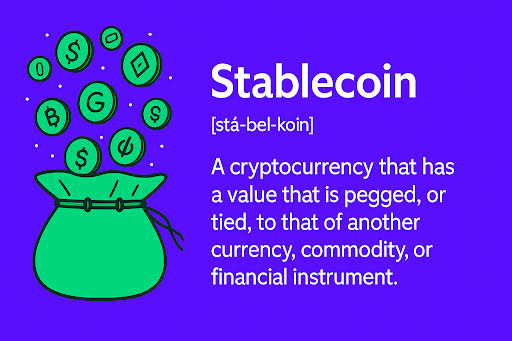
A stablecoin is a digital asset designed to maintain a relatively stable value relative to a reference asset or currency.
The most common reference is the US dollar.
For example, a dollar-pegged stablecoin may aim to maintain a value close to $1.
This does not mean that the price can never move. Market conditions, liquidity, demand, and the mechanism used by the stablecoin can cause temporary or sometimes significant deviations from its target.
The goal is to reduce the volatility normally associated with many cryptocurrencies.
Stablecoins can operate on blockchain networks, allowing users to transfer digital representations of value while using the infrastructure of those networks.
Why Were Stablecoins Created?
One of the biggest challenges of cryptocurrencies is price volatility.
Bitcoin and many other cryptocurrencies can experience significant price movements over relatively short periods.
This volatility can make them difficult to use for certain everyday financial activities.
Imagine receiving a cryptocurrency as payment and discovering that its value has fallen significantly before you can use it.
Stablecoins were developed in part to address this problem.
By attempting to maintain a stable value relative to a reference asset, they can provide a digital asset that is easier to use for trading, transfers, savings-like applications, and decentralized financial services.
Stablecoins effectively combine some characteristics of traditional currencies with blockchain-based infrastructure.
How Do Stablecoins Work?
The way a stablecoin maintains its value depends on its design.
There is no single mechanism used by all stablecoins.
Some stablecoins are backed by reserves of traditional assets or highly liquid financial instruments.
Others use cryptocurrency collateral.
There are also algorithmic or partially algorithmic systems that attempt to maintain their target value through programmed mechanisms and market incentives.
Understanding the stabilization mechanism is essential because it determines many of the stablecoin’s risks.
Fiat-Backed Stablecoins
Fiat-backed stablecoins are designed to be supported by reserves associated with traditional currencies or other financial assets.
A common model is a stablecoin that aims to maintain a value of approximately one US dollar for each token in circulation.
The issuer may hold reserves intended to support the stablecoin.
Depending on the specific project, these reserves can include cash, bank deposits, short-term government securities, or other assets.
The exact composition of reserves is extremely important.
Users should examine what assets actually back a stablecoin, how those reserves are managed, and what information the issuer provides about them.
Crypto-Backed Stablecoins
Another category is crypto-backed stablecoins.
Instead of relying primarily on traditional financial assets, these stablecoins use cryptocurrencies as collateral.
Because cryptocurrencies can be highly volatile, these systems often use overcollateralization.
For example, a user might deposit more cryptocurrency than the value of the stablecoins they receive.
This additional collateral can provide a buffer against price movements.
If the collateral falls below certain thresholds, the system may automatically liquidate some of the collateral according to its rules.
Crypto-backed stablecoins are closely associated with decentralized finance because they can operate through smart contracts rather than depending entirely on a centralized issuer.
Algorithmic Stablecoins
Algorithmic stablecoins use programmed mechanisms and economic incentives to attempt to maintain their target value.
Rather than relying entirely on traditional reserves, the system may adjust supply, incentives, or other parameters depending on market conditions.
This model has attracted significant attention because it can potentially reduce dependence on traditional collateral.
However, it can also introduce substantial risks.
If users lose confidence in the system or market conditions become extreme, the mechanisms designed to maintain the peg may fail.
For this reason, algorithmic stablecoins should be evaluated carefully.
What Does “Pegged to the Dollar” Mean?
When a stablecoin is described as being “pegged” to the US dollar, it means that the project is designed to maintain a target value close to $1.
The term “peg” does not necessarily mean that the token will always trade at exactly $1.
Market demand and liquidity can cause temporary differences.
For example, a stablecoin designed to track the US dollar could trade slightly above or below its target.
The ability of the system to restore the intended value depends on its specific design, reserves, liquidity, redemption mechanisms, and market incentives.
Why Are Stablecoins Important?
Stablecoins have become an important bridge between traditional finance and the cryptocurrency ecosystem.
They allow users to hold and transfer digital assets that are designed to have relatively stable values while taking advantage of blockchain infrastructure.
They are widely used in cryptocurrency markets.
Traders can use stablecoins to move between volatile assets and a dollar-denominated digital asset without necessarily converting back into traditional bank currency every time.
Stablecoins are also widely used in decentralized finance.
Stablecoins and Cryptocurrency Trading
Stablecoins play an important role in cryptocurrency exchanges.
Many trading pairs use stablecoins as a quote asset.
For example, a cryptocurrency might be traded against a dollar-denominated stablecoin.
This allows traders to compare the price of different digital assets against a relatively stable reference.
Stablecoins can also make it easier for traders to move capital between different exchanges and blockchain networks, although fees, liquidity, transfer times, and network compatibility still need to be considered.
Stablecoins and DeFi
Stablecoins are a fundamental component of Decentralized Finance, or DeFi.
DeFi applications use blockchain networks and smart contracts to provide financial services without relying on traditional intermediaries in the same way as conventional financial systems.
Stablecoins can be used in decentralized lending, borrowing, liquidity pools, decentralized exchanges, and other applications.
For example, a user may deposit stablecoins into a DeFi protocol and receive a return according to the protocol’s rules and market conditions.
However, earning a return on stablecoins does not mean the investment is risk-free.
Smart contract vulnerabilities, liquidity problems, platform failures, and changes in market conditions can result in losses.
Stablecoins for International Transfers
Another potential use of stablecoins is international money transfers.
Traditional international transfers can involve multiple financial institutions and may take time to process.
Blockchain-based stablecoin transfers can sometimes move value across borders more quickly, depending on the network and the services being used.
This can be particularly interesting for businesses and individuals operating across different countries.
However, users still need to consider regulatory requirements, transaction fees, exchange rates, taxation, and the availability of reliable on- and off-ramps.
What Are the Advantages of Stablecoins?
Stablecoins offer several potential advantages.
Lower Volatility
Their primary objective is to reduce price volatility compared with many other cryptocurrencies.
Blockchain-Based Transfers
Stablecoins can be transferred through blockchain networks, potentially allowing fast and global transactions depending on the network.
24/7 Availability
Unlike traditional banking systems that may operate according to specific schedules, blockchain networks can operate continuously.
Integration With DeFi
Stablecoins can interact with smart contracts and decentralized applications.
Digital Representation of Fiat Value
They can provide a digital representation of a traditional currency, such as the US dollar, within a blockchain ecosystem.
These advantages have contributed to their rapid adoption.
What Are the Risks of Stablecoins?
Despite their name, stablecoins are not completely risk-free.
One major risk is the possibility of losing the intended peg.
If a stablecoin designed to be worth $1 trades significantly below that value, users can suffer losses.
Another risk concerns the reserves.
If a stablecoin depends on reserves held by an issuer, users may need to trust that those reserves exist, are properly managed, and can support the outstanding tokens according to the system’s rules.
There is also counterparty risk.
A centralized issuer may face regulatory, financial, operational, or legal problems.
Crypto-backed stablecoins have different risks, including collateral volatility and liquidation mechanisms.
Algorithmic stablecoins can face additional risks if their stabilization mechanisms fail under extreme market conditions.
What Happens If a Stablecoin Loses Its Peg?
A stablecoin can temporarily or permanently move away from its target value.
This is known as depegging.
There can be several reasons for a depeg.
These may include:
- A sudden increase in selling pressure
- Lack of liquidity
- Concerns about reserves
- Problems with the issuer
- Smart contract vulnerabilities
- Market panic
- Insufficient collateral
- Failure of an algorithmic stabilization mechanism
The severity of a depeg can vary significantly.
A stablecoin may recover its target value relatively quickly, or it may experience a prolonged loss of confidence.
This is why understanding how the stablecoin maintains its peg is so important.
How Can You Evaluate a Stablecoin?
Before using a stablecoin, it is useful to investigate several factors.
First, determine what backs the stablecoin.
If it is reserve-backed, find out what the reserves consist of.
Next, examine how transparent the issuer is.
Does it regularly publish information about reserves? Are there independent reports or attestations? What are the terms for redeeming tokens?
You should also examine the blockchain infrastructure supporting the stablecoin.
Another important factor is liquidity.
A stablecoin with significant liquidity and broad adoption may be easier to trade than one with limited market activity.
Finally, consider the regulatory environment and the jurisdiction in which the issuer operates.
Stablecoins vs. Traditional Dollars
A stablecoin and a US dollar are not the same thing.
A dollar is a sovereign currency issued by the United States and exists within the traditional financial system.
A stablecoin is a digital asset that attempts to maintain a value relative to a currency or another reference asset.
Depending on the stablecoin, users may have different rights regarding redemption and reserves.
Therefore, users should not automatically assume that holding one unit of a dollar-pegged stablecoin is legally identical to holding one dollar in a bank account.
The Regulation of Stablecoins
Stablecoins have attracted increasing attention from regulators around the world.
Governments and financial authorities are examining issues such as reserve requirements, consumer protection, transparency, financial stability, anti-money-laundering rules, and redemption rights.
Regulation varies significantly between jurisdictions and continues to evolve.
For users and businesses, this means that the legal status and permitted uses of a particular stablecoin may depend on the country in which they operate.
Anyone using stablecoins for significant financial activities should understand the rules that apply to them.
The Future of Stablecoins
Stablecoins are likely to remain an important part of the digital asset ecosystem.
Their ability to combine blockchain infrastructure with relatively stable values makes them useful for trading, payments, decentralized finance, and other applications.
Financial institutions, technology companies, and blockchain projects are also exploring different forms of digital money and tokenized assets.
At the same time, stablecoins face important challenges.
These include regulation, reserve transparency, scalability, security, interoperability, and maintaining user confidence.
The projects that succeed in the long term will likely be those that can provide reliable infrastructure, transparent operations, strong security, and genuine utility.
Conclusion
A stablecoin is a digital asset designed to maintain a relatively stable value relative to a reference asset, most commonly the US dollar.
Unlike many cryptocurrencies, which can experience significant price volatility, stablecoins aim to provide greater stability while maintaining the advantages of blockchain-based transfers.
There are several types of stablecoins, including fiat-backed, crypto-backed, and algorithmic models. Each has its own mechanisms, advantages, and risks.
Stablecoins are now an important part of cryptocurrency trading and decentralized finance. They can also be used for digital transfers, payments, and other blockchain-based applications.
However, the word “stable” should not be interpreted as “risk-free.” Stablecoins can lose their peg, issuers can face financial or regulatory problems, and smart contracts can contain vulnerabilities.
For anyone entering the cryptocurrency ecosystem, understanding how stablecoins work is essential.
Stablecoins represent an important connection between traditional currencies and blockchain technology, offering a way to move and use digital value while attempting to reduce some of the volatility associated with cryptocurrencies.
