What Is Blockchain? A Complete Guide for Beginners
Blockchain technology has become one of the most important concepts in the cryptocurrency world. Although many people are familiar with Bitcoin or Ethereum, not everyone understands the technology that allows these networks to operate without depending on a bank or a central company.
Blockchain, also known as distributed ledger technology, is a system that allows information to be recorded and shared among different participants in a network using a distributed structure. Depending on how each network is designed, this technology can provide transparency, traceability, and resistance to certain types of data modification.
But what exactly is blockchain? How does it work? What does a block contain? Why can certain information be so difficult to modify? And what can this technology be used for beyond cryptocurrencies?
In this article, we will explain in simple terms what blockchain is, how it works, its main characteristics, and some of its potential applications.
What Is Blockchain?
A blockchain is a distributed digital ledger in which information is organized into blocks that are connected to one another.
We can think of it as a shared digital accounting book. In a traditional company, a financial record may be stored on the organization’s servers and managed by specific people.
On a decentralized blockchain, however, different participants can maintain copies of the information and verify that transactions follow the rules established by the protocol.
Blocks contain information and are cryptographically connected to previous blocks. This structure creates a chain of blocks that records the evolution of information within the network.
Although blockchain has become popular mainly because of cryptocurrencies, its potential applications are much broader.
Why Is It Called a Blockchain?
The name blockchain comes from the combination of two English words: block and chain.
Transactions or other types of data are grouped into blocks. These blocks are then added to the chain according to the rules of the network.
Each block can contain different elements depending on the blockchain. These may include transactions, a reference to the previous block, information related to the consensus process, and other technical data.
The connection between blocks helps protect the integrity of the recorded history.
If someone attempted to modify information contained in an older block, they would have to overcome the cryptographic and consensus mechanisms used by the network.
How Does a Blockchain Work?
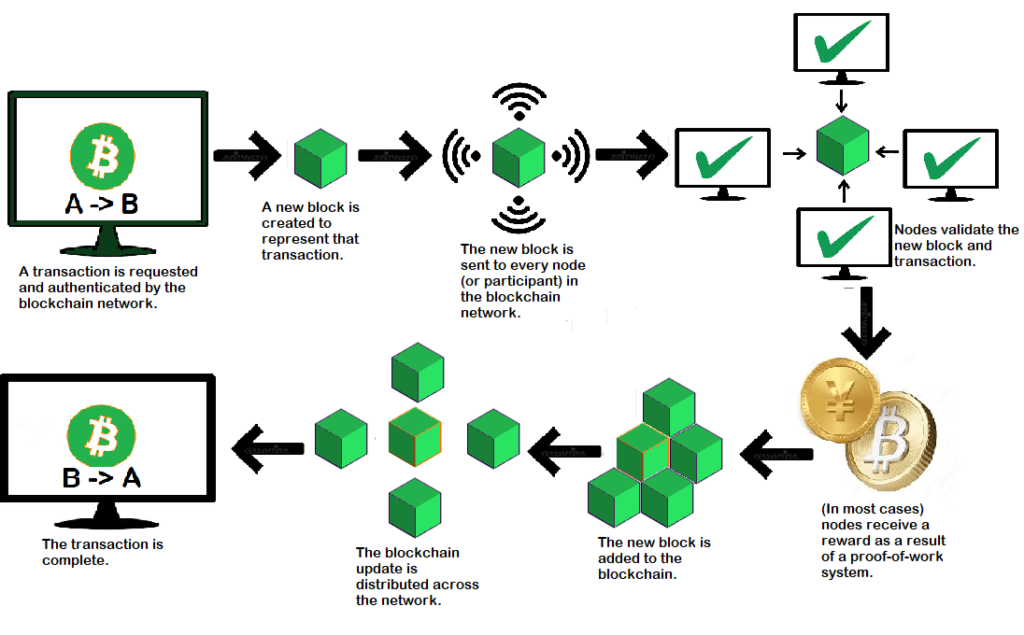
Although each blockchain may have different characteristics, its operation can be summarized in several steps.
First, a user initiates an operation. For example, they may send a certain amount of cryptocurrency to another address.
The transaction is broadcast to the network, where different participants can check whether it follows the protocol’s rules.
Valid transactions can then be grouped into a block.
Depending on the consensus mechanism used, certain participants are responsible for proposing, creating, or validating that block.
Once the block is accepted by the network, it is added to the blockchain.
As new blocks are added, a history of transactions is created that can be consulted and verified according to the characteristics of the network.
What Does a Block Contain?
A block can contain different types of information depending on the blockchain.
In a cryptocurrency network, it can typically include a collection of transactions.
It also usually contains information that links it to the previous block. This connection is important because it allows the blocks to form an ordered structure.
Blocks can also contain other technical information used by the protocol, such as timestamps or data related to the consensus mechanism.
One of the fundamental elements is the hash.
A hash is the result of applying a mathematical function to certain data. In simple terms, we can think of it as a kind of digital fingerprint of the information.
If the data used to generate the hash changes, the resulting hash will also change.
This helps detect modifications to stored information.
What Is a Hash?
Hashing is one of the fundamental concepts of blockchain technology.
A hash function converts specific information into a string of characters of a certain length, depending on the algorithm being used.
For example, if we enter a piece of text into a hash function, we will obtain a specific result. If we change even a small part of the text, the result can be completely different.
In blockchains, hashes are used for various functions related to data integrity and network security.
One of their applications is linking blocks together.
This means that modifying information in a block can affect its hash and disrupt its connection with subsequent blocks.
What Are Blockchain Nodes?
Nodes are computers that participate in a blockchain network.
Depending on the network and the type of node, they can perform different functions.
Some nodes store blockchain information and verify transactions. Others may participate in specific validation or consensus processes.
Having multiple nodes allows information and certain responsibilities to be distributed among numerous participants.
This is particularly important for decentralized networks.
Instead of relying on a single server, information can be replicated across different computers located in different places.
If one node stops operating, other nodes can continue participating in the network.
What Does It Mean for a Blockchain to Be Decentralized?
A decentralized blockchain is one in which control and operation do not depend exclusively on a single entity.
In a sufficiently distributed network, different participants can contribute to maintaining the ledger and validating transactions.
Decentralization can provide resistance against certain single points of failure and reduce dependence on a central authority.
However, it is important to understand that not all blockchains have the same level of decentralization.
Some networks may have a relatively small number of participants with particularly important roles, while others are designed to distribute control more broadly.
Therefore, when analyzing a blockchain, it is useful to examine who controls the infrastructure, how decisions are made, and how its consensus mechanism works.
What Is a Consensus Mechanism?
In a blockchain network, participants need a way to agree on which information is valid and what should become part of the network’s history.
This process is known as consensus.
There are different consensus mechanisms.
Proof of Work
Proof of Work uses computing power to participate in creating new blocks and securing the network.
Bitcoin uses this mechanism.
Miners compete by using computing power to solve cryptographic problems and, according to the protocol’s rules, may receive rewards for their participation.
Proof of Stake
Proof of Stake uses a different model.
Participants can stake or lock certain assets to participate in the network’s validation process.
According to the protocol’s rules, they may receive rewards for contributing to the operation and security of the blockchain.
There are also other mechanisms and variations designed for different requirements.
Public and Private Blockchains
Not all blockchains are designed in the same way.
A public blockchain allows anyone to participate or access certain parts of the network, depending on its rules.
Bitcoin and other public networks are examples of systems designed to operate openly.
A private blockchain, on the other hand, may be controlled by a company or organization and restrict who can access or participate in the network.
Private blockchains can have applications in business environments where organizations want to benefit from certain characteristics of distributed ledgers without creating a completely open network.
Is Blockchain Information Immutable?
One of the best-known characteristics of blockchain technology is the difficulty of modifying information once it has been recorded.
However, saying that a blockchain is absolutely “immutable” can be an oversimplification.
The possibility of modifying information depends on the network’s architecture, consensus mechanism, number of participants, and other technical characteristics.
On certain public and widely distributed blockchains, changing the transaction history would require overcoming significant security and consensus mechanisms.
For this reason, it is often more accurate to describe blockchain information as resistant to modification, rather than assuming that every piece of data on every blockchain is mathematically impossible to change.
What Is Blockchain Used For?
Blockchain applications go far beyond cryptocurrencies.
One of its main uses is recording financial transactions.
It can also be used to create smart contracts, which are programs that run on certain blockchain networks according to predefined rules.
Smart contracts have made it possible to develop decentralized applications, commonly known as dApps.
These applications can be used in areas such as finance, gaming, digital marketplaces, and identity systems.
Blockchain can also be used in certain traceability systems, where it is important to record the movement or history of products or information.
However, using blockchain is not always the best solution. A traditional database can be simpler, faster, and less expensive in certain situations.
Blockchain and Cryptocurrencies
Although blockchain and cryptocurrencies are closely related, they are not exactly the same thing.
A cryptocurrency is a digital asset that can operate within a particular network.
A blockchain is the technology or infrastructure used by many of these networks to record information and coordinate transactions.
Bitcoin, for example, uses its own blockchain to record BTC transactions.
Ethereum also has its own blockchain, but its purpose goes beyond simply transferring ether. The network allows smart contracts to run and supports different types of applications.
Therefore, cryptocurrencies can be considered one of the best-known applications of blockchain technology, but they do not represent its entire potential.
Advantages of Blockchain Technology
Blockchain can offer several advantages depending on how it is designed.
One of them is transparency. On certain public networks, users can view recorded transactions.
Another is traceability, since information can be organized into a historical record that makes it possible to follow certain operations.
Blockchain can also provide resistance against certain unauthorized changes through the combination of cryptography and consensus mechanisms.
Decentralization is another important characteristic of certain networks, as it allows functions to be distributed among different participants.
In addition, smart contracts make it possible to automate certain operations and create applications that operate according to programmed rules.
Disadvantages and Limitations of Blockchain
Despite its advantages, blockchain also has limitations.
Some networks can experience scalability problems when the number of users and transactions increases significantly.
Depending on the consensus mechanism, operating a blockchain can also require considerable resources.
Transaction fees can increase during periods of high demand.
In addition, a public blockchain can record information permanently, so it is important to carefully consider what data is placed on it.
Technical complexity can also make blockchain difficult to use for people who are not familiar with the technology.
Finally, not every project that uses the word “blockchain” necessarily has a real use case or sustainable business model.
The Future of Blockchain
Blockchain technology continues to evolve.
Developers are working on solutions designed to improve areas such as scalability, transaction speed, interoperability between networks, and user experience.
New applications are also emerging around decentralized finance, digital assets, identity systems, and different models of digital ownership.
However, significant technical, regulatory, and economic challenges remain.
The future of blockchain will depend largely on its ability to solve real-world problems and provide concrete advantages over traditional technologies.
Conclusion
A blockchain is essentially a distributed digital ledger that organizes information into interconnected blocks using cryptographic mechanisms and relies on specific consensus rules to coordinate network participants.
This technology makes it possible to record transactions and other types of information without necessarily depending on a single central authority.
Cryptocurrencies are one of its best-known applications, but blockchain can also be used for smart contracts, decentralized applications, traceability systems, and other digital services.
Understanding how blockchain works is essential for understanding the cryptocurrency ecosystem. Concepts such as blocks, hashes, nodes, consensus, and decentralization form the technological foundation behind many of the networks we use today.
As the technology continues to evolve, it will be important to distinguish between projects that provide real solutions and those that simply use blockchain as a marketing term.
Blockchain is not simply the technology behind Bitcoin. It is a different way of organizing and sharing information among multiple participants, and its true potential will depend on the applications that can use it to solve real-world problems efficiently and securely.
