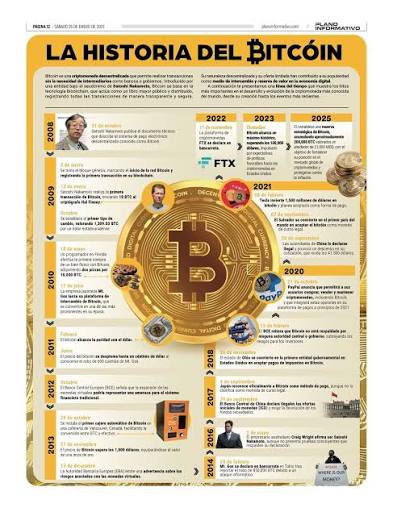
The History of Bitcoin: From Its Origins to the Present Day
Bitcoin has become one of the most recognized names in the world of finance and technology. What began as an experimental digital currency in 2009 has developed into a global financial asset, a decentralized payment network, and one of the most influential technological projects of the 21st century.
The history of Bitcoin is particularly interesting because its creation was not an isolated event. Bitcoin emerged from decades of research into cryptography, digital money, privacy, computer networks, and decentralized systems.
Understanding Bitcoin’s history helps explain why the cryptocurrency was designed the way it was and why concepts such as decentralization, limited supply, Proof of Work, and peer-to-peer transactions are so important to the network.
In this article, we will explore the history of Bitcoin from its technological origins and the appearance of Satoshi Nakamoto to the launch of the network, its early adoption, major developments, halvings, institutional interest, and its evolution into a global digital asset.
The Origins of Digital Money
Although Bitcoin was launched in 2009, the idea of digital money is much older.
During the 1980s and 1990s, researchers and computer scientists began exploring ways to create digital currencies that could operate over the internet.
One of the major challenges was the double-spending problem.
With physical cash, if you give someone a banknote, you no longer possess that same banknote.
Digital information is different. A computer file can normally be copied.
A digital currency therefore needs a system that prevents someone from copying the same digital unit and spending it multiple times.
Several researchers attempted to solve this problem using cryptography and centralized or partially centralized systems.
Projects such as DigiCash and e-gold demonstrated that there was interest in digital forms of money, although these systems ultimately faced significant technical, economic, or regulatory limitations.
These early experiments helped create the intellectual environment from which Bitcoin eventually emerged.
The Cypherpunk Movement
Another important influence on Bitcoin came from the cypherpunk movement.
Cypherpunks were developers, researchers, and activists interested in using cryptography to protect privacy and enable secure communication.
During the 1990s, members of this community discussed the possibility of creating digital forms of money that would reduce dependence on governments, banks, and centralized institutions.
Several proposals emerged from this environment.
Hashcash
In 1997, Adam Back introduced Hashcash, a Proof of Work system originally designed to help combat email spam and certain forms of network abuse.
Bitcoin would later use a related Proof of Work concept as part of its mining and security system.
B-Money
In 1998, Wei Dai proposed B-money, a conceptual system for decentralized digital money.
B-money included ideas involving distributed databases and participants maintaining records of transactions.
Although B-money was never implemented as a functioning cryptocurrency, some of its ideas were conceptually similar to later aspects of Bitcoin.
Bit Gold
Nick Szabo also proposed a concept known as Bit Gold.
Bit Gold explored the idea of creating scarce digital units using cryptographic processes and computational work.
Like B-money, Bit Gold was never launched as a fully operational cryptocurrency, but it is often discussed as an important intellectual precursor to Bitcoin.
These projects demonstrate that Bitcoin did not appear from nowhere.
Instead, it combined and developed ideas that had been explored by many researchers over several decades.
The Arrival of Satoshi Nakamoto
In 2008, a person or group using the pseudonym Satoshi Nakamoto entered the conversation.
On October 31, 2008, Nakamoto published the Bitcoin white paper titled:
Bitcoin: A Peer-to-Peer Electronic Cash System.
The document described a system that would allow electronic payments to be sent directly from one participant to another without going through a financial institution.
The proposal combined several existing technologies and concepts, including cryptographic signatures, Proof of Work, peer-to-peer networking, and a distributed transaction history.
One of the most important innovations was the way Bitcoin combined these elements to address the double-spending problem without requiring a central authority.
The identity of Satoshi Nakamoto remains unknown.
Despite numerous claims over the years, no individual has been conclusively proven to be the person or group behind the pseudonym.
The Bitcoin Genesis Block
On January 3, 2009, Satoshi Nakamoto mined the first block of the Bitcoin blockchain.
This block is known as the Genesis Block, or Block 0.
It represents the beginning of the Bitcoin network.
Embedded within the Genesis Block was a message referencing a newspaper headline:
“The Times 03/Jan/2009 Chancellor on brink of second bailout for banks.”
The message has often been interpreted as a reference to the financial crisis of 2008 and the instability of the traditional banking system.
Whether the message was intended as a political statement, a timestamp, or both, it became a symbolic part of Bitcoin’s history.
The Genesis Block also established the first bitcoin reward, although the coins associated with this block are not spendable in the same way as ordinary mined bitcoin.
The First Bitcoin Transaction
The first known Bitcoin transaction between two individuals occurred on January 12, 2009.
Satoshi Nakamoto sent 10 BTC to computer scientist and cryptographer Hal Finney.
Finney was an early Bitcoin participant and one of the first people to run the Bitcoin software.
He became an important figure in Bitcoin’s early history and contributed feedback and testing to the project.
At this stage, Bitcoin had almost no monetary value.
It was primarily an experiment among a small group of cryptography enthusiasts and developers.
Bitcoin’s Early Years
During 2009 and 2010, Bitcoin remained a relatively obscure project.
The software was available to anyone interested in running it, and users could mine bitcoin using ordinary computers.
There was no established cryptocurrency market comparable to today’s exchanges.
The network consisted of a relatively small community of users.
Bitcoin’s value was difficult to determine because there was almost no established market for it.
However, the project gradually attracted more developers and enthusiasts.
One of the most important developments was the creation of early Bitcoin marketplaces where users could exchange bitcoin for traditional currencies.
This helped transform Bitcoin from an experimental technology into a marketable digital asset.
The First Real-World Bitcoin Purchase
One of the most famous events in Bitcoin history occurred in May 2010.
A Bitcoin user named Laszlo Hanyecz offered 10,000 BTC in exchange for two pizzas.
Another community member accepted the offer and purchased the pizzas for him.
This event became known as Bitcoin Pizza Day and is remembered as one of the first documented real-world purchases using bitcoin.
At the time, 10,000 BTC had a relatively small market value.
Today, the amount would be worth vastly more, making the story one of the most famous examples of Bitcoin’s extraordinary price appreciation over the years.
More importantly, the transaction demonstrated that bitcoin could be used as a medium of exchange for a real-world product.
The Rise of Bitcoin Exchanges
As interest in Bitcoin increased, cryptocurrency exchanges began to appear.
These platforms made it easier for users to buy and sell bitcoin using traditional currencies.
One of the most influential early exchanges was Mt. Gox.
Originally created for trading cards, Mt. Gox was transformed into a Bitcoin exchange and eventually became one of the largest Bitcoin trading platforms in the world.
Its growth demonstrated the increasing demand for cryptocurrency markets.
However, Mt. Gox would later become one of the biggest failures in Bitcoin history.
The Mt. Gox Collapse
In 2014, Mt. Gox collapsed after announcing that a large amount of bitcoin had been lost or stolen.
Approximately 850,000 BTC were reported missing, although some were later recovered.
The collapse caused major disruption in the cryptocurrency market and highlighted the risks associated with centralized exchanges.
It also reinforced an important principle within the cryptocurrency community:
Not your keys, not your coins.
The phrase refers to the difference between holding cryptocurrency directly through your own wallet and allowing a third party to control the private keys.
The Mt. Gox incident demonstrated that the security of Bitcoin itself and the security of companies built around Bitcoin are two different things.
Bitcoin and the 2017 Bull Market
Bitcoin’s next major period of global attention came in 2017.
The cryptocurrency market experienced enormous growth, and Bitcoin’s price increased dramatically.
Public interest expanded rapidly.
Media coverage increased, new cryptocurrency projects were launched, and millions of people became interested in blockchain technology.
Bitcoin’s price reached close to $20,000 in December 2017 before experiencing a major decline in the following year.
The period became an important lesson about the extreme volatility of cryptocurrency markets.
It also helped establish Bitcoin as a mainstream financial and technological topic.
The Bitcoin Scaling Debate
As Bitcoin adoption increased, the network faced questions about scalability.
Bitcoin’s blockchain has a limited capacity for processing transactions directly on its base layer.
As demand increased, users sometimes experienced higher transaction fees and longer waiting times.
The Bitcoin community debated how the network should evolve.
Some participants wanted to increase the block size, while others argued that larger blocks could make it more difficult for ordinary users to operate full nodes.
The debate eventually contributed to the creation of Bitcoin Cash, which split from Bitcoin in August 2017.
Bitcoin itself continued developing through other approaches, including improvements to transaction efficiency and second-layer technologies.
The SegWit Upgrade
One of the most important technical upgrades in Bitcoin’s history was Segregated Witness, commonly known as SegWit.
SegWit was activated on the Bitcoin network in August 2017.
The upgrade changed how transaction data and signatures were stored, improving the effective capacity of the blockchain and enabling additional technical developments.
SegWit also played an important role in the development of the Lightning Network.
This demonstrated that Bitcoin could evolve through protocol upgrades while maintaining its decentralized governance structure.
The Lightning Network
The Lightning Network is a Layer 2 technology designed to enable faster and potentially cheaper Bitcoin transactions.
Instead of recording every transaction directly on the Bitcoin blockchain, participants can use payment channels and settle transactions on the main network according to the system’s rules.
The technology aims to make Bitcoin more practical for smaller and frequent payments.
Although the Lightning Network is still developing, it represents an important part of Bitcoin’s evolution beyond its original base-layer design.
Bitcoin Halvings
Another major part of Bitcoin’s history is the series of halving events.
A Bitcoin halving reduces the block subsidy paid to miners by approximately half.
The first halving occurred in 2012.
The second took place in 2016.
The third occurred in 2020.
The fourth occurred in 2024.
These events gradually reduce the rate at which new bitcoins enter circulation.
The halving mechanism is built into Bitcoin’s protocol and contributes to its predetermined monetary policy.
Because the supply of new bitcoin decreases over time, halvings have attracted significant attention from investors and analysts.
However, a halving does not guarantee that Bitcoin’s price will increase.
Market prices depend on many factors beyond the rate of new issuance.
Bitcoin During the COVID-19 Pandemic
In 2020, the global COVID-19 pandemic created enormous economic uncertainty.
Financial markets experienced severe volatility.
Bitcoin initially declined alongside many other risk assets but later entered a major period of growth.
Institutional and corporate interest also increased.
Companies and investors began discussing Bitcoin as a potential alternative asset and possible hedge against monetary expansion.
This period helped move Bitcoin further into mainstream financial discussions.
Institutional Adoption
During the early 2020s, institutional interest in Bitcoin increased significantly.
Some companies added Bitcoin to their corporate treasury strategies.
Financial institutions began developing cryptocurrency-related products and services.
Professional investors increasingly treated Bitcoin as an asset class worth analyzing.
This represented a significant change from Bitcoin’s early days, when it was primarily used by a relatively small community of developers and enthusiasts.
Institutional adoption also contributed to greater integration between cryptocurrency markets and traditional financial infrastructure.
Bitcoin and El Salvador
In September 2021, El Salvador became the first country to adopt Bitcoin as legal tender alongside the US dollar.
The decision attracted international attention and generated significant debate.
Supporters argued that Bitcoin could improve access to financial services and facilitate international remittances.
Critics raised concerns about price volatility, adoption, consumer protection, and the government’s approach.
The experiment became an important case study in the relationship between cryptocurrency and national monetary policy.
Bitcoin ETFs and Mainstream Finance
Another major milestone occurred in the United States in January 2024, when the Securities and Exchange Commission approved the listing and trading of spot Bitcoin exchange-traded products.
This development made it possible for investors to gain exposure to Bitcoin through traditional financial market infrastructure without necessarily managing Bitcoin directly.
The introduction of these products represented another step toward the integration of Bitcoin into mainstream investment markets.
It also demonstrated how Bitcoin had evolved from an obscure internet experiment into an asset followed by major financial institutions.
Bitcoin Today
Today, Bitcoin is a global cryptocurrency network with millions of users and a large ecosystem of developers, miners, exchanges, custodians, payment providers, financial institutions, and other businesses.
Its market value has experienced enormous fluctuations throughout its history.
Bitcoin has gone through multiple bull markets and bear markets, regulatory controversies, technological debates, exchange failures, and major changes in public perception.
Despite these challenges, the network has continued operating since its launch in 2009.
Bitcoin is now discussed in a wide range of contexts, including finance, technology, monetary policy, investment, cybersecurity, and digital ownership.
What Makes Bitcoin’s History Important?
Bitcoin’s history is important because it demonstrates how a relatively simple idea can develop into a global technological ecosystem.
Bitcoin began as a proposal published by an anonymous creator.
It had no established market value, no institutional investors, and no mainstream recognition.
Over time, developers improved the software, users began adopting it, exchanges created markets, businesses experimented with payments, investors entered the ecosystem, and institutions began offering financial products related to Bitcoin.
The network also faced significant challenges.
These included exchange failures, security incidents, scaling debates, regulatory uncertainty, extreme price volatility, and competition from thousands of other cryptocurrencies.
Yet Bitcoin has continued to evolve.
The Future of Bitcoin
Nobody can predict exactly what Bitcoin will look like decades from now.
The network may become increasingly integrated with traditional financial systems.
It may become more widely used as a digital asset or store of value.
Technologies such as the Lightning Network could expand its role as a payment system.
Regulation could also significantly influence how individuals, businesses, and financial institutions interact with Bitcoin.
At the same time, Bitcoin will continue to face challenges.
These may include energy consumption, scalability, competition, regulation, cybersecurity, and market volatility.
Its future will ultimately depend on continued technological development, network security, user adoption, and demand.
Conclusion
The history of Bitcoin is the story of how an experimental digital currency evolved into one of the world’s most recognized financial and technological innovations.
Bitcoin’s roots can be traced to decades of research into cryptography, digital money, privacy, and decentralized networks.
In 2008, Satoshi Nakamoto published the Bitcoin white paper, and in January 2009, the first block of the Bitcoin blockchain was created.
From there, Bitcoin developed through a series of important milestones: its first transactions, the emergence of exchanges, Bitcoin Pizza Day, the rise and fall of Mt. Gox, the 2017 bull market, the scaling debate, SegWit, the Lightning Network, multiple halvings, increasing institutional adoption, and the integration of Bitcoin into traditional financial markets.
Perhaps the most remarkable part of Bitcoin’s history is that it has continued operating without a central company controlling the entire network.
Bitcoin’s story is still being written. What began as a proposal for a peer-to-peer electronic cash system has become a global experiment in decentralized money, digital scarcity, and financial technology. Whatever its ultimate role in the future of finance, Bitcoin has already changed the way the world thinks about money and decentralized digital assets.
