How Does Bitcoin Work? A Complete Guide for Beginners
Bitcoin is one of the most important developments in the history of digital finance. Since its launch in 2009, it has introduced a new way of transferring and storing value without relying on a traditional bank or centralized financial institution.
However, understanding how Bitcoin actually works can be difficult at first. Terms such as blockchain, mining, nodes, private keys, Proof of Work, wallets, and cryptography can make the technology seem complicated.
The basic idea is actually easier to understand when we break the system into its main components.
Bitcoin is a decentralized digital currency that uses a peer-to-peer network, cryptography, blockchain technology, and a consensus mechanism called Proof of Work to allow users to transfer value without a central authority.
In this guide, we will explain how Bitcoin works, how transactions are created and verified, what the blockchain does, how mining secures the network, how wallets and private keys work, and why the Bitcoin system can operate without a central bank.
What Is Bitcoin?
Bitcoin is a decentralized digital asset and payment network.
Unlike traditional currencies, Bitcoin is not issued or controlled by a central bank.
Instead, its network consists of computers distributed around the world that communicate with one another and follow a common set of rules.
These rules determine how transactions are created, how blocks are produced, how new bitcoins are issued, and how the network reaches agreement about its transaction history.
Bitcoin’s blockchain provides a public record of transactions.
Cryptography is used to authorize transactions and help protect the integrity of the system.
This combination allows Bitcoin to operate without requiring a central organization to maintain a single master database.
The Main Components of Bitcoin
To understand how Bitcoin works, it is useful to separate the system into several components.
The most important are:
- The Bitcoin blockchain
- Nodes
- Bitcoin wallets
- Private and public keys
- Transactions
- Miners
- Proof of Work
- Consensus
- Bitcoin’s monetary policy
Each component performs a different function.
Together, they create the infrastructure that allows Bitcoin to operate as a decentralized network.
The Bitcoin Blockchain
The blockchain is the public ledger that records Bitcoin transactions.
Transactions are grouped together into blocks.
Each block contains information that connects it to the previous block.
This creates a chronological chain of blocks.
The blockchain allows network participants to determine the history of transactions and calculate the current state of Bitcoin ownership according to the protocol’s rules.
One of the most important characteristics of the Bitcoin blockchain is that copies of the ledger are maintained by many independent computers.
There is therefore no single central database that contains the only valid record.
What Are Bitcoin Nodes?
Nodes are computers that participate in the Bitcoin network.
A Bitcoin node can communicate with other nodes, receive transactions, verify them, and store blockchain data.
Full nodes are particularly important because they independently verify transactions and blocks according to Bitcoin’s rules.
For example, a full node can check whether a transaction is properly formed and whether the bitcoins being spent are valid according to the blockchain’s history.
Nodes help prevent invalid transactions from becoming part of the network’s accepted history.
The distributed nature of nodes is one of the reasons Bitcoin can operate without a central server.
How Does a Bitcoin Transaction Work?
Suppose Alice wants to send bitcoin to Bob.
Alice uses her Bitcoin wallet to create a transaction.
The transaction specifies the relevant Bitcoin inputs, the amount being transferred, and Bob’s destination address.
Alice’s wallet uses her private key to generate a cryptographic signature.
This signature proves that the person creating the transaction has the authority to spend the relevant bitcoin.
The transaction is then broadcast to the Bitcoin network.
Nodes receive the transaction and check whether it follows the protocol’s rules.
If it is valid, it can be relayed to other participants and eventually included in a block by a miner.
What Are Bitcoin Addresses?
A Bitcoin address is a destination that can be used to receive bitcoin.
It is derived from cryptographic information associated with a wallet.
Users can generate multiple addresses and do not necessarily need to reuse the same address for every transaction.
When someone wants to send bitcoin to another person, they enter the recipient’s address into their wallet.
Because transactions can be difficult or impossible to reverse after confirmation, users should carefully verify the destination address before approving a transaction.
What Are Private Keys?
Private keys are one of the most important security elements in Bitcoin.
A private key is secret cryptographic information that can be used to authorize transactions involving bitcoin controlled by that key.
The simplest way to think about it is as a digital authorization mechanism.
If someone obtains control of your private keys, they may be able to move the associated bitcoin.
This is why private keys should never be shared.
Bitcoin wallets can manage private keys in different ways, and modern wallets often use a recovery phrase that can regenerate the necessary keys.
Anyone who controls the recovery phrase may potentially control the associated funds.
What Is a Bitcoin Wallet?
A Bitcoin wallet is software or hardware that manages the cryptographic information needed to interact with the Bitcoin network.
It is important to understand that bitcoin itself is not stored inside the wallet.
The blockchain contains the transaction history.
The wallet stores or manages the credentials needed to authorize transactions and determine which funds the user can control.
There are several types of wallets.
Software wallets run on computers or mobile devices.
Hardware wallets use specialized physical devices designed to protect private keys.
Custodial wallets are managed by third-party platforms such as cryptocurrency exchanges.
Each option involves different levels of convenience, security, and personal responsibility.
What Happens After a Transaction Is Broadcast?
Once Alice broadcasts her transaction, it enters the Bitcoin network.
Nodes verify it according to the protocol’s rules.
Valid transactions can be held in a pool of unconfirmed transactions, often called the mempool.
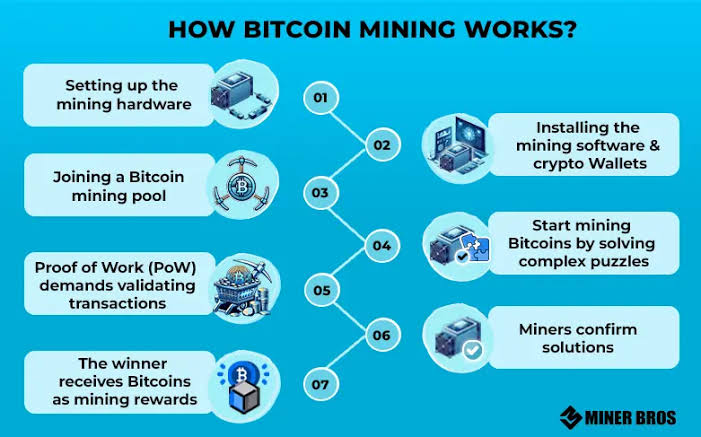
Miners select transactions from this pool and organize them into candidate blocks.
They then compete to find a valid Proof of Work solution.
The successful miner can broadcast the block to the network.
Other nodes independently verify the block.
If the block is valid, they accept it and add it to their copy of the blockchain.
Alice’s transaction now has its first confirmation.
What Is Bitcoin Mining?
Bitcoin mining is the process used by the network’s Proof of Work consensus mechanism.
Miners use specialized computers to perform large numbers of cryptographic calculations.
Their objective is to find a valid hash that satisfies the current difficulty requirements.
This process requires significant computing power and electricity.
When a miner successfully produces a valid block, the block is broadcast to the network.
Other nodes verify it.
If it follows Bitcoin’s rules, the block becomes part of the blockchain.
Mining therefore helps determine which transactions become part of Bitcoin’s permanent transaction history.
What Is Proof of Work?
Proof of Work is the consensus mechanism used by Bitcoin.
The system requires miners to demonstrate that they have performed computational work.
The mining process involves repeatedly calculating hashes while changing specific information within the candidate block.
The probability of finding a valid solution depends largely on the amount of computational power being used.
Because producing valid blocks requires real-world resources, attempting to manipulate the network can become extremely expensive.
This is one of the key security properties of Bitcoin’s design.
Why Is Mining Necessary?
Mining serves several functions.
First, it helps secure the blockchain.
Second, it provides a mechanism for ordering transactions.
Third, it creates a competitive process through which new blocks are added to the network.
Fourth, mining is how new bitcoins are introduced into circulation according to Bitcoin’s monetary policy.
Without a consensus mechanism, decentralized participants would have difficulty agreeing on the valid history of transactions.
Bitcoin uses Proof of Work to address this problem.
What Is Bitcoin’s Difficulty Adjustment?
Bitcoin is designed to produce blocks at a relatively predictable rate.
However, the total amount of computing power participating in mining can change.
If more miners join the network, the amount of computing power increases.
Bitcoin therefore periodically adjusts the mining difficulty.
When mining power increases, the difficulty can increase.
When mining power decreases, the difficulty can decrease.
This mechanism helps keep block production aligned with the protocol’s target.
It also means that simply adding more mining hardware does not permanently make blocks appear faster.
What Is a Bitcoin Block?
A Bitcoin block contains a collection of transactions and other information required by the protocol.
One important part of the block is its connection to the previous block.
This relationship creates the chain structure.
Blocks also contain information associated with the mining process.
Once a block has been accepted by the network, it becomes part of the blockchain.
New blocks continue to build on top of previous ones.
This creates a growing history of Bitcoin transactions.
What Are Bitcoin Confirmations?
A confirmation occurs when a transaction is included in an accepted block.
If another block is added after that block, the transaction has an additional confirmation.
For example:
- Transaction included in a block = 1 confirmation
- One additional block = 2 confirmations
- Two additional blocks = 3 confirmations
The more confirmations a transaction receives, the deeper it becomes in the blockchain’s history.
There is no universal number of confirmations that is appropriate for every transaction.
Businesses and users can choose different thresholds depending on the amount involved and their risk tolerance.
Why Are Bitcoin Transactions Difficult to Reverse?
Bitcoin does not have a central authority that can simply cancel a transaction.
Once a transaction has been included in the blockchain and additional blocks are added, reversing it becomes increasingly difficult.
A malicious participant attempting to rewrite the transaction history would need to overcome the network’s Proof of Work and consensus mechanisms.
This does not mean Bitcoin transactions are absolutely irreversible in every theoretical circumstance.
Rather, the network is designed so that reversing sufficiently confirmed transactions becomes computationally and economically difficult.
How Is the Bitcoin Supply Controlled?
Bitcoin’s monetary policy is encoded in its protocol.
The total supply is designed to be limited to approximately 21 million BTC.
New bitcoins are introduced through the block subsidy paid to miners.
However, this subsidy is periodically reduced through Bitcoin halvings.
A halving cuts the block subsidy approximately in half.
This creates a gradually decreasing rate of new bitcoin issuance.
The predictable nature of Bitcoin’s monetary policy is one of its most distinctive characteristics.
What Is Bitcoin Halving?
A Bitcoin halving occurs after a predetermined number of blocks have been mined.
The event reduces the number of new bitcoins created with each block.
The first halving took place in 2012.
Additional halvings occurred in 2016, 2020, and 2024.
Each halving reduces the flow of newly created bitcoin.
Eventually, the block subsidy will become extremely small.
According to Bitcoin’s current issuance schedule, the final fractions of bitcoin are expected to be mined around the year 2140, although the exact timing depends on how the network’s blocks are produced.
After the block subsidy effectively ends, miners are expected to rely primarily on transaction fees for revenue.
What Are Bitcoin Transaction Fees?
Bitcoin users can include fees with their transactions.
These fees compensate miners for including transactions in blocks.
When demand for blockchain space is high, users may compete by offering higher fees for faster inclusion.
When demand is lower, fees can generally be lower.
Transaction fees are not the same as the price of bitcoin.
They are payments made to miners for processing and including transactions in blocks.
The fee market is an important component of Bitcoin’s long-term security model.
What Makes Bitcoin Decentralized?
Bitcoin’s decentralization comes from the distribution of several functions.
There are independent nodes verifying the blockchain.
There are miners competing to produce blocks.
There are developers working on the software.
There are users running wallets and transacting on the network.
There are businesses and infrastructure providers supporting the ecosystem.
No single participant necessarily controls all of these functions.
However, decentralization is not an absolute concept.
The distribution of mining power, node operators, development influence, ownership, and infrastructure can change over time.
Bitcoin’s Security Model
Bitcoin’s security comes from several technologies working together.
Cryptographic signatures help prove authorization for transactions.
Hash functions help connect blocks and protect data integrity.
Proof of Work makes block production costly.
Nodes independently verify transactions and blocks.
Economic incentives encourage miners to follow the protocol.
Together, these mechanisms create a system where attacking the network can be extremely expensive.
Bitcoin’s security does not come from one single technology.
It comes from the interaction between cryptography, distributed networking, consensus rules, economic incentives, and computing resources.
Can Bitcoin Be Hacked?
It is important to distinguish between hacking Bitcoin itself and attacking individual users or services.
The Bitcoin protocol has strong security mechanisms, but users can still lose funds through phishing, malware, stolen private keys, fraudulent websites, compromised exchanges, or other attacks.
For example, if a person accidentally gives their wallet recovery phrase to a scammer, the Bitcoin network itself cannot prevent the scammer from using the stolen credentials.
Similarly, a centralized exchange can be hacked or experience operational problems even though the Bitcoin blockchain continues operating normally.
This distinction is essential when evaluating Bitcoin security.
Bitcoin and the Lightning Network
Bitcoin’s base blockchain has limited transaction capacity.
To support additional use cases, developers have created second-layer technologies such as the Lightning Network.
Lightning allows users to conduct transactions through payment channels without recording every individual transaction directly on the Bitcoin blockchain.
Transactions can therefore be faster and potentially less expensive.
The Bitcoin blockchain can then provide settlement and security for the underlying system.
Lightning is one example of how additional layers can be built around Bitcoin’s base network.
How Is Bitcoin Different From a Bank?
The differences between Bitcoin and traditional banking are significant.
In a bank, the institution maintains account balances and processes transactions.
The bank can potentially freeze accounts, reverse certain transactions, and provide customer support.
With Bitcoin, users can hold their own private keys and interact directly with the network.
There is no central Bitcoin company that can reset a wallet password or reverse an ordinary transaction.
This gives users greater control but also greater responsibility.
Self-custody means that protecting private keys becomes the user’s responsibility.
Advantages of Bitcoin
Bitcoin has several characteristics that have attracted users and investors.
Decentralization
Bitcoin does not depend on a single central authority.
Scarcity
The protocol limits the maximum supply to approximately 21 million BTC.
Transparency
The blockchain allows transactions to be publicly inspected and independently verified.
Divisibility
Bitcoin can be divided into 100 million satoshis.
Global Accessibility
People can interact with the Bitcoin network from many parts of the world without opening a traditional bank account.
Portability
Bitcoin can be transferred digitally without physically transporting an asset.
These characteristics have contributed to Bitcoin’s growing importance.
Risks and Limitations
Bitcoin also has limitations.
Its market price can be extremely volatile.
The network’s base layer has limited transaction capacity.
Mining consumes significant amounts of electricity.
Users who manage their own private keys are responsible for securing them.
Regulatory treatment varies between countries.
Bitcoin transactions can also be difficult to reverse.
These characteristics mean that Bitcoin is not suitable for every person or every financial situation.
Understanding both the advantages and disadvantages is essential before using it.
Conclusion
Bitcoin works by combining blockchain technology, cryptography, decentralized networking, Proof of Work mining, and economic incentives.
When a user sends bitcoin, their wallet creates and cryptographically signs a transaction.
The transaction is broadcast to the network, where nodes verify that it follows Bitcoin’s rules.
Miners collect valid transactions into blocks and compete to produce a valid Proof of Work solution.
When a block is accepted, it is added to the blockchain.
Additional blocks provide further confirmations and make the transaction increasingly difficult to reverse.
At the same time, Bitcoin’s protocol controls the creation of new coins through mining rewards and periodically reduces new issuance through halvings.
The result is a decentralized monetary network that can operate without a central bank maintaining the transaction ledger.
Understanding how Bitcoin works is essential for understanding the broader cryptocurrency ecosystem. Bitcoin is not simply a digital coin stored on a website or application; it is an entire decentralized network in which cryptography, computers, economic incentives, and predefined rules work together to create a global system for transferring and recording digital value.
