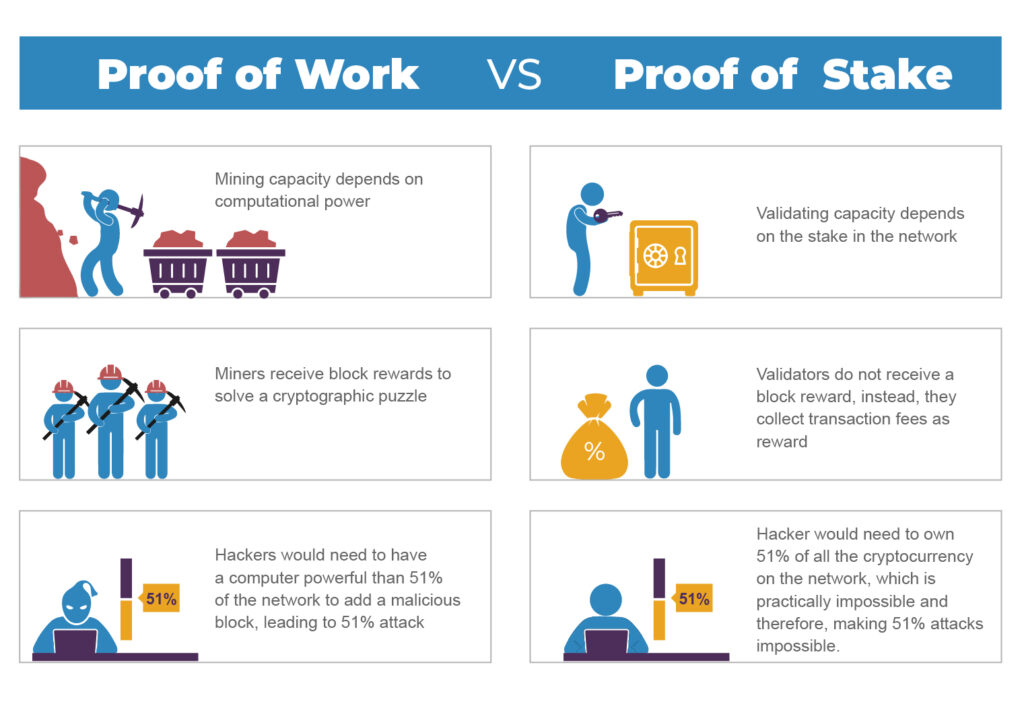
Proof of Work vs. Proof of Stake: What Is the Difference?
Proof of Work and Proof of Stake are two of the most important consensus mechanisms used by blockchain networks.
If you are learning about cryptocurrencies, you will often encounter these terms when researching how Bitcoin, Ethereum, and other blockchain networks operate. Although both systems have the same broad objective—helping a decentralized network agree on which transactions and blocks are valid—they achieve this goal in very different ways.
Proof of Work (PoW) relies on computational power and energy. Participants called miners compete to solve cryptographic problems and add new blocks to the blockchain.
Proof of Stake (PoS) uses cryptocurrency as an economic commitment. Participants called validators lock or “stake” assets and are selected according to the network’s rules to help validate blocks and transactions.
The differences between these mechanisms affect security, energy consumption, hardware requirements, decentralization, incentives, and the overall design of a blockchain.
In this guide, we will explain how Proof of Work and Proof of Stake operate, their main advantages and disadvantages, how they compare, and why the choice of consensus mechanism matters for a cryptocurrency network.
What Is a Consensus Mechanism?
Before comparing Proof of Work and Proof of Stake, it is important to understand what consensus means in a blockchain.
A decentralized blockchain does not have a central administrator who decides which transactions are valid.
Instead, thousands of computers may participate in maintaining the network.
These computers need a way to agree on the current state of the blockchain.
A consensus mechanism provides the rules and incentives that allow participants to reach this agreement.
The system must help answer several important questions:
- Which transactions are valid?
- Which block should be added next?
- How should participants be rewarded?
- What happens when participants disagree?
- How can malicious behavior be discouraged?
Different blockchain networks solve these problems in different ways.
Proof of Work and Proof of Stake are two of the most important approaches.
What Is Proof of Work?
Proof of Work is a consensus mechanism that requires participants to perform computational work.
The best-known example is Bitcoin.
In a Proof of Work network, miners compete to create new blocks.
They use specialized hardware to perform large numbers of calculations.
The objective is to find a valid solution to a mathematical problem that satisfies the network’s current difficulty requirements.
When a miner finds a valid solution, the proposed block can be broadcast to the network.
Other nodes verify the block.
If the block follows the protocol’s rules, it can be added to the blockchain.
The miner may then receive a block reward and transaction fees.
How Does Proof of Work Mining Operate?
The process begins with transactions.
Users broadcast transactions to the network.
Nodes verify those transactions according to the protocol.
Miners select transactions and construct candidate blocks.
The miner then attempts to find a valid Proof of Work solution.
This involves repeatedly calculating cryptographic hashes while changing information in the candidate block.
The miner is effectively searching for a result that satisfies a particular condition.
Because the result of a cryptographic hash is unpredictable, miners must perform many attempts.
The more computational power a miner has, the greater its probability of finding the next valid block.
When a miner succeeds, the block is broadcast.
Other nodes independently verify it.
If it is valid, it becomes part of the blockchain.
Why Does Proof of Work Provide Security?
Proof of Work creates a real-world cost associated with block production.
Mining requires hardware, electricity, cooling, maintenance, and other resources.
An attacker attempting to rewrite significant parts of the blockchain would need enormous computational resources.
This makes attacks expensive.
The security model is based partly on the idea that honest mining should be economically preferable to attempting to manipulate the network.
For a large Proof of Work blockchain, controlling enough computational power to dominate block production can require substantial investment.
Advantages of Proof of Work
Strong Security Model
Proof of Work has been used by Bitcoin since its launch in 2009.
The system has demonstrated its ability to secure a large decentralized network over many years.
High Cost of Attacks
Manipulating a large Proof of Work network requires significant computational resources and electricity.
This creates an economic barrier against certain attacks.
Open Participation
Anyone with appropriate mining equipment and access to electricity can potentially participate in mining.
However, profitability depends on many factors, including hardware costs, electricity prices, competition, and network difficulty.
Established Technology
Proof of Work is one of the oldest and most extensively studied blockchain consensus mechanisms.
Bitcoin provides the most prominent real-world example.
Disadvantages of Proof of Work
High Energy Consumption
The most common criticism of Proof of Work is its energy consumption.
Miners use substantial amounts of electricity to perform computations.
The environmental impact depends on the sources of that electricity and the broader circumstances of mining.
Supporters argue that mining can use renewable energy and electricity that might otherwise be wasted.
Critics argue that the energy requirements create environmental costs.
The debate remains complex.
Specialized Hardware
Modern Proof of Work mining, particularly for Bitcoin, relies heavily on specialized hardware known as ASICs.
This can make mining more expensive for ordinary individuals.
Although the protocol may be open to anyone, the economics of large-scale mining can favor participants with access to specialized equipment and inexpensive electricity.
Mining Concentration
Large mining operations can achieve economies of scale.
This can lead to concerns about mining concentration.
If a relatively small number of large mining companies control a significant portion of the network’s computational power, questions can arise about decentralization.
However, mining pools and individual miners remain separate concepts, and the overall distribution of mining power can change over time.
What Is Proof of Stake?
Proof of Stake takes a fundamentally different approach.
Instead of competing through computational work, participants commit cryptocurrency to the network.
These participants are generally called validators.
To participate, a validator typically needs to lock a certain amount of cryptocurrency according to the network’s rules.
The protocol then selects validators to propose or attest to blocks.
Validators receive rewards for correctly participating.
They can also face penalties if they violate important protocol rules.
The exact mechanics differ between Proof of Stake blockchains.
Ethereum, for example, uses Proof of Stake.
How Does Proof of Stake Work?
A simplified Proof of Stake process looks like this:
First, participants deposit or lock cryptocurrency according to the network’s requirements.
They become eligible to participate as validators.
The protocol uses its rules to determine which validators propose blocks and which validators attest to them.
Other validators examine the proposed information.
If the block follows the protocol’s rules, it can be accepted.
Validators can receive rewards for honest participation.
Certain malicious or prohibited behaviors can result in penalties.
The system therefore uses economic incentives rather than computational competition as the primary mechanism for securing the network.
Why Does Proof of Stake Provide Security?
Proof of Stake makes participants financially invested in the network.
Validators generally need to lock cryptocurrency to participate.
If they behave dishonestly, they can potentially lose some of their stake through protocol penalties.
This creates an economic incentive to follow the rules.
The system is designed so that attacking the network can become financially expensive.
However, the exact security model depends heavily on the implementation of each Proof of Stake blockchain.
Advantages of Proof of Stake
Lower Direct Energy Consumption
One of the most significant advantages of Proof of Stake is that it does not require miners to perform massive amounts of computational work.
Validators do not need to compete by continuously running specialized machines to solve cryptographic puzzles.
As a result, Proof of Stake networks can operate with substantially lower direct electricity requirements than comparable Proof of Work systems.
Lower Hardware Requirements
Proof of Stake does not require specialized mining hardware.
Validators generally need appropriate computing equipment and internet connectivity, but the hardware requirements are typically very different from those of large-scale Proof of Work mining.
This can make participation more accessible in some circumstances.
Economic Incentives
Proof of Stake directly connects network participation with an economic stake.
Validators have an incentive to protect the value and functionality of the network because they have assets committed to it.
The possibility of penalties can discourage certain types of malicious behavior.
Potential Scalability Benefits
Many Proof of Stake networks have been designed with scalability in mind.
Because block production does not depend on energy-intensive mining competitions, developers can explore different approaches to increasing network capacity.
However, Proof of Stake itself does not automatically solve blockchain scalability.
Scalability depends on the broader architecture of the network.
Disadvantages of Proof of Stake
Wealth Concentration
One common criticism of Proof of Stake is the possibility that participants with larger cryptocurrency holdings could have greater influence.
If the ability to participate or earn rewards depends on the amount of cryptocurrency staked, large holders may have more economic weight.
Different networks use different mechanisms to address this issue.
The concern nevertheless remains an important part of the Proof of Stake debate.
Technical Complexity
Proof of Stake systems can be technically complex.
The rules governing validator selection, staking, rewards, penalties, network finality, and malicious behavior can be complicated.
This complexity can create additional challenges for developers, validators, and users.
Slashing and Penalties
Some Proof of Stake networks use a mechanism known as slashing.
Under certain circumstances, a validator can lose part of its staked assets for violating protocol rules.
This provides a strong incentive to behave correctly, but it also creates additional risks for validators who make technical mistakes or experience certain infrastructure failures.
Different Security Assumptions
Proof of Stake does not provide exactly the same security model as Proof of Work.
Instead of relying primarily on computational expenditure, it relies heavily on economic incentives and the value of staked assets.
This creates a different set of assumptions and potential attack models.
Proof of Work vs. Proof of Stake
The most important differences can be summarized as follows:
| Feature | Proof of Work | Proof of Stake |
|---|---|---|
| Main participants | Miners | Validators |
| Resource used | Computing power and electricity | Staked cryptocurrency |
| Block production | Mining competition | Validator-based process |
| Specialized hardware | Often important | Generally not required |
| Energy consumption | Relatively high | Relatively low |
| Main incentive | Block rewards and fees | Staking rewards and fees |
| Penalties | Primarily economic losses from failed mining or attacks | Possible protocol penalties or slashing |
| Example | Bitcoin | Ethereum |
This comparison provides a useful overview, but each blockchain implements its consensus mechanism differently.
Which Is More Decentralized?
There is no simple answer.
Decentralization depends on many factors.
For Proof of Work, researchers may examine the distribution of mining power, mining pools, hardware manufacturers, electricity access, and geographic concentration.
For Proof of Stake, factors include the distribution of staked assets, validator concentration, delegation systems, governance structures, and barriers to participation.
A blockchain cannot be classified as decentralized simply because it uses Proof of Work or Proof of Stake.
The details of the network matter.
Which Is More Secure?
Both mechanisms can provide strong security, but they rely on different assumptions.
Proof of Work security is strongly connected to computational expenditure and the cost of controlling a large portion of the network’s mining power.
Proof of Stake security is strongly connected to the economic value committed by validators and the penalties that can be imposed for certain malicious behavior.
Bitcoin’s long history makes Proof of Work particularly significant as a proven security model.
Proof of Stake has also become an important technology and is used by major blockchain networks.
Security should therefore be evaluated on a network-by-network basis.
Which Uses Less Energy?
Proof of Stake generally uses significantly less electricity for consensus than Proof of Work.
This is because validators do not need to perform massive amounts of repetitive computation to compete for block production.
For this reason, Proof of Stake is often presented as a more energy-efficient alternative.
However, energy efficiency is only one factor when evaluating a blockchain.
Security, decentralization, censorship resistance, scalability, governance, and economic incentives are also important.
Why Does Bitcoin Use Proof of Work?
Bitcoin’s creator selected Proof of Work as a fundamental part of the network’s design.
The mechanism helps Bitcoin create a decentralized process for ordering transactions and producing blocks.
Mining creates a measurable cost associated with block production.
This cost helps protect the blockchain against certain attacks.
Bitcoin’s continued use of Proof of Work is closely connected to its philosophy of decentralized verification and permissionless participation.
Changing Bitcoin’s consensus mechanism would represent an enormous change to the network and would have significant technical and social consequences.
Why Did Ethereum Move to Proof of Stake?
Ethereum originally used Proof of Work.
In September 2022, Ethereum completed its transition to Proof of Stake in an upgrade commonly known as The Merge.
The change replaced Ethereum’s mining-based consensus mechanism with validator-based Proof of Stake.
One major motivation was to significantly reduce Ethereum’s direct energy consumption associated with consensus.
The transition demonstrated that an established blockchain could fundamentally change its consensus architecture.
However, Ethereum’s transition does not mean that Proof of Stake is universally superior.
Bitcoin and Ethereum have different goals, architectures, communities, and design philosophies.
Can Proof of Work and Proof of Stake Coexist?
Yes.
There is no requirement that all blockchain networks use the same consensus mechanism.
Some networks use Proof of Work.
Others use Proof of Stake.
There are also many variations and hybrid systems.
The appropriate consensus mechanism depends on the goals of the blockchain.
A network focused on maximum decentralization and a conservative monetary system may make different choices from a network designed to support complex applications and smart contracts.
Proof of Work and Proof of Stake: Which Is Better?
The answer depends on what you mean by “better.”
If energy efficiency is the main priority, Proof of Stake has an important advantage.
If long-term operational history and a simple security concept based on physical resource expenditure are priorities, Proof of Work has strong arguments in its favor.
If low barriers to hardware participation are important, Proof of Stake can be attractive.
If the objective is to create a monetary network based on expensive computational work and a predictable issuance system, Proof of Work may be more appropriate.
There is no single consensus mechanism that is perfect for every blockchain.
The Importance of Consensus in Cryptocurrency
Consensus is one of the foundations of blockchain technology.
Without consensus, decentralized participants would not have a reliable way to agree on the state of the network.
Proof of Work and Proof of Stake represent two different answers to the same fundamental question:
How can a decentralized network agree on a shared history without relying on a central authority?
Proof of Work answers this question through computational work and energy expenditure.
Proof of Stake answers it primarily through economic commitment and incentives.
Understanding this distinction helps explain why different cryptocurrencies have very different technical and economic characteristics.
The Future of Blockchain Consensus
Blockchain technology continues to evolve.
Developers are researching improvements to security, scalability, decentralization, energy efficiency, and user experience.
Proof of Work is likely to remain important, particularly because Bitcoin continues to use it.
Proof of Stake has also become a major part of the blockchain ecosystem.
Other consensus mechanisms may continue to emerge as developers experiment with new approaches.
The future may therefore contain a diverse range of blockchain architectures rather than one universal consensus model.
Conclusion
Proof of Work and Proof of Stake are two fundamentally different approaches to blockchain consensus.
Proof of Work uses computational power and electricity to secure a network. Proof of Stake uses cryptocurrency locked by validators and economic incentives to achieve consensus.
Proof of Work has the advantage of a long operational history, particularly through Bitcoin, and creates a clear physical cost associated with block production. Its main disadvantages include significant energy consumption, specialized hardware requirements, and potential concerns about mining concentration.
Proof of Stake generally requires much less direct energy and eliminates the need for competitive mining. It can provide an efficient way to coordinate validators, but it introduces different concerns, including potential wealth concentration, technical complexity, and staking-related risks.
Neither mechanism is automatically perfect.
The right choice depends on the objectives and design philosophy of each blockchain.
Understanding Proof of Work and Proof of Stake is essential for anyone interested in cryptocurrency because consensus is at the heart of how decentralized networks function. By understanding how these mechanisms differ, users can better understand why Bitcoin, Ethereum, and other blockchain networks operate in such different ways.
