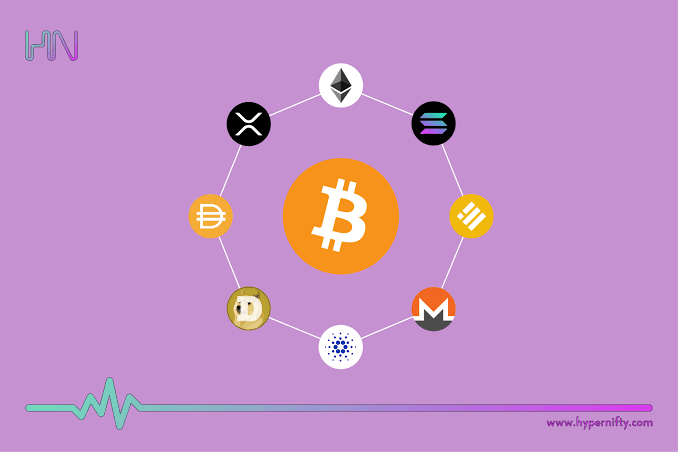
What Are Altcoins? A Complete Guide to Alternative Cryptocurrencies
The cryptocurrency market is much larger than Bitcoin.
Since Bitcoin was introduced in 2009, thousands of other cryptocurrencies have been created. These digital assets have introduced new technologies, different blockchain architectures, alternative consensus mechanisms, and new ways of using cryptocurrency.
Most cryptocurrencies other than Bitcoin are commonly referred to as altcoins.
The word “altcoin” comes from the expression “alternative coin.” Originally, the term was used to describe cryptocurrencies created as alternatives to Bitcoin. Today, it is generally used as a broad term for cryptocurrencies other than Bitcoin, although the exact definition can vary depending on the context.
Some altcoins are designed to provide smart-contract platforms. Others focus on payments, privacy, scalability, decentralized finance, gaming, interoperability, or other applications.
Understanding altcoins is important for anyone who wants to understand the cryptocurrency ecosystem beyond Bitcoin.
In this guide, we will explain what altcoins are, how they work, why they were created, the main types of altcoins, their advantages and risks, and what factors should be considered when researching an altcoin.
What Does “Altcoin” Mean?
An altcoin is generally a cryptocurrency other than Bitcoin.
The term does not describe one specific technology.
Instead, it represents a broad category containing thousands of different digital assets.
Some altcoins have their own independent blockchains.
For example, Ethereum operates its own blockchain, and ETH is its native cryptocurrency.
Other altcoins are associated with blockchain networks designed for specialized purposes.
Some focus on smart contracts.
Others prioritize fast transactions or low fees.
Some are designed around privacy.
Others are created primarily as community-driven or speculative assets.
Because the term covers such a large variety of projects, it is important not to assume that all altcoins work in the same way.
Why Were Altcoins Created?
Bitcoin introduced a new model for decentralized digital money.
However, developers and researchers quickly began exploring whether blockchain technology could be used for other purposes.
Some projects attempted to modify Bitcoin’s technology.
Others created completely new blockchain architectures.
Developers wanted to experiment with:
- Faster transactions
- Different mining algorithms
- Alternative consensus mechanisms
- Smart contracts
- Greater privacy
- New monetary policies
- Decentralized applications
- Interoperability
- Scalability
These experiments resulted in the creation of many different cryptocurrencies.
Over time, the term “altcoin” became a general way to describe cryptocurrencies other than Bitcoin.
The Early History of Altcoins
The first major alternative cryptocurrencies appeared soon after Bitcoin.
One of the earliest examples was Namecoin, launched in 2011.
Namecoin was based on Bitcoin’s technology but attempted to provide a decentralized domain-name system.
Another important early cryptocurrency was Litecoin.
Litecoin was launched in 2011 by Charlie Lee and was designed as a cryptocurrency inspired by Bitcoin but with several technical differences.
These early projects demonstrated that Bitcoin’s underlying concepts could be modified and adapted for different purposes.
As developers became more interested in blockchain technology, the number of cryptocurrencies increased rapidly.
Litecoin: One of the First Major Altcoins
Litecoin is one of the best-known early altcoins.
It was created as a peer-to-peer digital currency inspired by Bitcoin.
Litecoin uses a different hashing algorithm from Bitcoin and has a shorter target block interval.
The project was designed to provide faster transaction confirmation times while maintaining a decentralized cryptocurrency model.
Litecoin helped establish the idea that developers could create alternative cryptocurrencies based on the concepts introduced by Bitcoin.
Although thousands of newer cryptocurrencies have appeared since then, Litecoin remains one of the longest-running altcoins.
Ethereum and the Evolution of Altcoins
Ethereum represented an important evolution in the cryptocurrency ecosystem.
Rather than focusing primarily on digital payments, Ethereum was designed as a programmable blockchain.
Its smart-contract functionality allows developers to create decentralized applications that operate using blockchain infrastructure.
This opened the door to an entirely new category of blockchain projects.
Ethereum helped create ecosystems involving:
- Decentralized finance
- NFTs
- Decentralized exchanges
- DAOs
- Tokenization
- Blockchain games
- Web3 applications
The success of Ethereum demonstrated that cryptocurrencies could be part of broader software platforms rather than simply digital payment systems.
Main Types of Altcoins
Because the term altcoin includes many different cryptocurrencies, it is useful to divide them into broad categories.
Payment Altcoins
Some altcoins are primarily designed for transferring digital value.
Their goal may be to provide fast, inexpensive, or private digital payments.
These cryptocurrencies can compete with Bitcoin by offering different technical characteristics.
Smart-Contract Platforms
Some altcoins are native assets of blockchain platforms that support smart contracts.
Examples include ETH, SOL, ADA, and AVAX.
These networks provide infrastructure for developers to build decentralized applications.
The native cryptocurrency can be used to pay transaction fees and participate in the network’s economic system.
Stablecoins
Stablecoins are digital assets designed to maintain a relatively stable value.
Many stablecoins reference fiat currencies such as the U.S. dollar.
They are widely used within cryptocurrency markets for trading, transfers, and decentralized finance.
Although stablecoins are often discussed separately from traditional altcoins, they technically belong to the broader category of cryptocurrencies other than Bitcoin.
Privacy-Focused Altcoins
Some cryptocurrencies focus on improving transaction privacy.
Traditional public blockchains can make transaction information visible to anyone who examines the blockchain.
Privacy-focused projects use different technologies to make transactions more difficult to trace or associate with specific users.
The methods used vary considerably between projects.
Meme Coins
Meme coins are cryptocurrencies inspired by internet memes, jokes, popular culture, or online communities.
Some meme coins have achieved enormous popularity and significant market valuations.
However, they can also be extremely speculative.
Their prices can be heavily influenced by social media trends, public attention, celebrity activity, and market sentiment.
Altcoins vs. Bitcoin
The most obvious difference between Bitcoin and altcoins is that Bitcoin was the first cryptocurrency and remains the largest and most established digital asset by market capitalization.
Bitcoin’s primary objective is decentralized digital money.
Many altcoins have broader or more specialized objectives.
For example, Ethereum focuses on programmable blockchain infrastructure.
Solana emphasizes high-performance applications.
Cardano focuses on a research-oriented blockchain architecture.
Other projects focus on interoperability, privacy, gaming, or specialized financial applications.
This means that comparing Bitcoin with an altcoin requires understanding the purpose of both networks.
Altcoins vs. Coins and Tokens
The term “altcoin” and the terms “coin” and “token” describe different things.
An altcoin is generally a cryptocurrency other than Bitcoin.
A coin is typically the native asset of its own blockchain.
A token usually operates on top of an existing blockchain.
For example, ETH is the native coin of Ethereum.
A token created using Ethereum’s infrastructure does not have to operate its own independent blockchain.
This distinction can be useful when researching a cryptocurrency.
An altcoin can be a native coin of an independent blockchain, while many tokens are also considered part of the broader altcoin market.
How Do Altcoins Work?
The technology behind an altcoin depends on the specific project.
Some use Proof of Work.
Others use Proof of Stake.
Some use variations or combinations of different consensus technologies.
The basic process generally involves a blockchain network consisting of nodes and other participants.
Transactions are broadcast to the network.
Participants verify those transactions according to the protocol’s rules.
A consensus mechanism determines how the network agrees on new blocks or changes to the blockchain.
The resulting blockchain provides a record of transactions and other activity.
Because different altcoins use different architectures, there is no single process that describes every altcoin.
Proof of Work Altcoins
Proof of Work is a consensus mechanism that uses computational power.
Miners compete to produce blocks by performing large numbers of calculations.
Bitcoin uses Proof of Work, and several altcoins have also used or continue to use this mechanism.
Proof of Work can provide a strong security model, but it can require significant energy and specialized hardware.
Some projects have experimented with different mining algorithms to create alternative approaches to Bitcoin mining.
Proof of Stake Altcoins
Proof of Stake uses economic participation rather than competitive computational work.
Participants generally lock cryptocurrency as a stake and become eligible to participate as validators.
Validators help process and verify blockchain activity.
They may receive rewards for following the network’s rules and can face penalties for certain forms of prohibited behavior.
Many modern blockchain platforms use Proof of Stake or related mechanisms.
The system generally requires less direct energy consumption than Proof of Work mining.
Why Are Altcoins Valuable?
The value of an altcoin can be influenced by several factors.
These can include:
- Supply and demand
- Network adoption
- Technology
- Utility
- Developer activity
- Community interest
- Liquidity
- Market sentiment
- Token economics
- Partnerships
- Broader cryptocurrency market conditions
However, having sophisticated technology does not automatically mean that an altcoin will have a high market value.
A project can have excellent technical features but fail to attract users.
Similarly, a cryptocurrency can experience rapid price growth primarily because of speculation.
Market Capitalization of Altcoins
Market capitalization is one of the most common metrics used to compare cryptocurrencies.
It is generally calculated as:
Market Capitalization = Current Price × Circulating Supply
This calculation is important because the price of one individual token does not tell you how valuable the entire network or asset is.
For example, a cryptocurrency priced at $1 can have a larger market capitalization than one priced at $100 if the first cryptocurrency has a much larger circulating supply.
This is why investors should not evaluate altcoins based solely on their unit price.
Altcoin Season
The term “altcoin season” is commonly used in cryptocurrency markets to describe periods when many altcoins outperform Bitcoin over a certain period.
During these periods, market participants may move capital toward alternative cryptocurrencies in search of higher returns.
Altcoin seasons can be driven by:
- Increased risk appetite
- Bitcoin market stability
- New technological developments
- Speculation
- Growth in decentralized applications
- Increased liquidity
- Market enthusiasm
However, altcoin seasons are not guaranteed to occur.
Altcoins can also experience significant declines when market sentiment changes.
Advantages of Altcoins
Altcoins can offer several potential advantages.
Innovation
Altcoins provide an environment for experimenting with new blockchain technologies.
Many blockchain innovations first appear in smaller projects before becoming more widely adopted.
Specialized Functions
Different altcoins can be designed for specific applications.
This allows developers to optimize networks for different objectives.
Competition
Competition between blockchain networks can encourage developers to improve scalability, security, usability, and functionality.
Diversification
For cryptocurrency users and investors, altcoins provide exposure to different blockchain ecosystems.
However, diversification does not eliminate risk.
Risks of Altcoins
Altcoins can involve considerably more risk than established cryptocurrencies.
Extreme Volatility
Some altcoins can experience very large price movements.
An asset that increases rapidly can also lose a significant portion of its value.
Project Failure
A project may fail to attract users, developers, or funding.
Technological promises do not guarantee long-term success.
Liquidity Risk
Smaller altcoins may have limited trading volume.
This can make buying or selling more difficult.
Security Vulnerabilities
Smart contracts and blockchain infrastructure can contain bugs.
An exploit can potentially result in significant losses.
Regulatory Uncertainty
The legal treatment of cryptocurrencies differs between jurisdictions.
Changes in regulations can affect projects and their users.
Scams
The ease of creating new cryptocurrencies has also created opportunities for fraudulent projects.
A professional website, large social media following, or impressive marketing campaign does not prove that an altcoin is legitimate.
How to Research an Altcoin
Anyone researching an altcoin should look beyond its price.
Several factors can provide useful information.
What Problem Does It Solve?
A project should have a clear purpose.
If it does not solve a meaningful problem or provide useful functionality, its long-term prospects may be questionable.
How Does the Technology Work?
Understand the blockchain architecture, consensus mechanism, and main features.
Who Develops It?
Research the development team and its track record.
How Active Is Development?
Regular development activity can indicate that a project is being maintained and improved.
Does the Network Have Users?
A blockchain can have impressive technology but little actual adoption.
Usage is therefore important.
What Is the Supply?
Check the circulating supply, maximum supply, inflation rate, and distribution.
Who Owns the Tokens?
Highly concentrated token ownership can create additional risks.
Is There Sufficient Liquidity?
Liquidity can affect how easily an asset can be traded.
What Are the Risks?
Every project has risks.
Understanding them is more important than simply focusing on potential profits.
Altcoins and the Cryptocurrency Market
Altcoins represent a large part of the cryptocurrency market.
When Bitcoin experiences strong growth, investor interest can sometimes spread to alternative cryptocurrencies.
However, altcoins frequently react more dramatically to market movements.
When investors become optimistic, some altcoins can rise rapidly.
When sentiment becomes negative, they can decline sharply.
This makes the altcoin market highly dynamic.
Macroeconomic conditions, regulation, technological developments, exchange activity, and changes in Bitcoin’s price can all influence altcoin markets.
The Future of Altcoins
The future of altcoins is difficult to predict.
The cryptocurrency industry is still developing, and technological competition remains intense.
Some existing altcoins may become important blockchain infrastructure.
Others may lose users and eventually disappear.
New blockchain technologies will likely continue to emerge.
Developers will experiment with improvements in scalability, privacy, interoperability, decentralized applications, and digital asset management.
The market may eventually become more concentrated around a smaller number of networks with strong utility and adoption.
Alternatively, specialized blockchains may coexist and serve different purposes.
Are Altcoins a Good Investment?
Whether an altcoin is a good investment depends on many factors, including an individual’s objectives, risk tolerance, financial situation, and understanding of the specific project.
There is no guarantee that an altcoin will increase in value.
Many cryptocurrencies experience substantial losses, and some projects can fail entirely.
For this reason, researching the underlying technology and project is generally more useful than simply following market hype.
Investors should also understand that past performance does not guarantee future results.
Conclusion
Altcoins are an important part of the cryptocurrency ecosystem.
The term generally refers to cryptocurrencies other than Bitcoin, although its exact usage can vary.
Altcoins were created for many different reasons.
Some attempt to improve digital payments.
Others provide smart-contract platforms, decentralized application infrastructure, privacy features, interoperability, or specialized functionality.
Major blockchain ecosystems such as Ethereum, Solana, Cardano, and Avalanche demonstrate how diverse the cryptocurrency landscape has become.
At the same time, altcoins can carry significant risks.
They can be highly volatile, vulnerable to technical problems, affected by regulation, and exposed to intense competition.
Some projects may succeed while others fail.
For anyone researching altcoins, it is therefore important to look beyond price charts and social media trends.
Understanding a project’s technology, purpose, adoption, development activity, token economics, liquidity, and risks provides a much stronger foundation for evaluating an altcoin.
The cryptocurrency industry will continue to evolve, and altcoins will likely remain an important part of that evolution. Some may become major blockchain networks, while others may disappear as the market matures.
Ultimately, the most important lesson is that not all altcoins are created equal. Each project should be evaluated on its own characteristics, technology, use cases, and risks rather than being judged solely by its price or popularity.
